Radio telescopes on the Moon's far side could detect dark matter
The Dark Ages signal could separate warm dark matter from cold, but no instrument capable of reading it has flown.
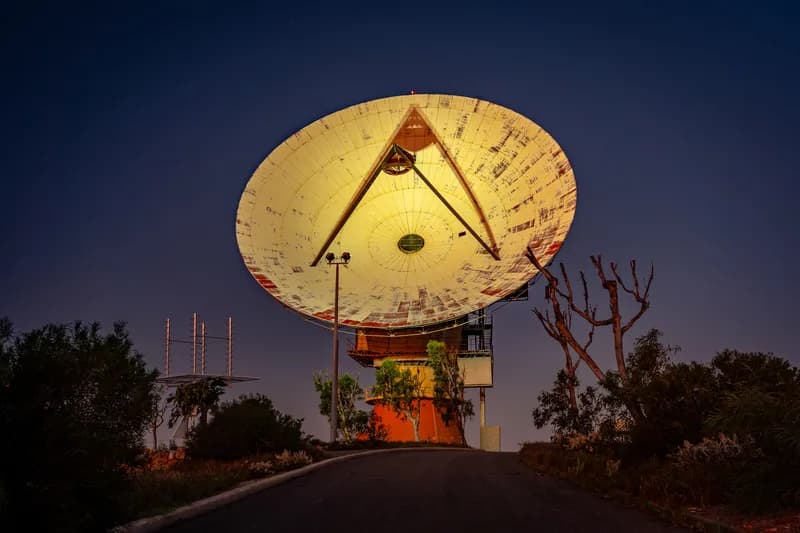
Faint radio waves that have been traveling since the Universe's infancy could carry a measurable fingerprint of dark matter, and the clearest place to read them is the far side of the Moon. That conclusion threads through a series of studies published over the past year, each pointing to the same radio-quiet lunar terrain as the best laboratory for one of the oldest unsolved problems in physics.
A team led from the University of Tsukuba, with the Kavli Institute for the Physics and Mathematics of the Universe, Tel Aviv University, Lawrence Berkeley National Laboratory, NIT Calicut and Cambridge, reported in Nature Astronomy on September 16, 2025, that advanced computer simulations show how those early signals could be shaped by the influence of dark matter. Ordinary matter, the stuff of stars, planets and diffuse intergalactic gas, accounts for only about 15 percent of all matter. The rest, roughly 85 percent, is dark matter that emits, absorbs and reflects no light.
Dark matter has never been seen directly, yet its gravity is thought to bind galaxies like the Milky Way and to shape the largest structures in the cosmos. In the present Universe, it has had billions of years to mingle with stars and galaxies, which muddies any reading of its properties. The early cosmos was cleaner, and that is where the new work looks.
Reading the cosmic dark ages
The Universe began about 13.8 billion years ago in the rapid expansion of the Big Bang. Roughly 380,000 years later, once the cosmos had cooled enough for atoms to form, it entered a long, quiet stretch that cosmologists call the Dark Ages. No stars had yet ignited, and neutral hydrogen gas filled space, emitting a faint radio signal that still echoes across the sky today.
| Mission or concept | Key detail |
|---|---|
| Chang'e-6 | Returned 1.935 kg from the Moon's far side on June 25, 2024 |
| Apollo program | Returned 382 kg of lunar rock in total |
| Lunar Crater Radio Telescope | Awarded $500,000 for NASA NIAC Phase II in 2021; concept only |
| CosmoCube | Would operate at 10 to 100 MHz in lunar orbit; concept only |
Source: NASA JPL, the UK Space Agency, CNSA and published papers, as of August 14, 2026
Rennan Barkana, a professor at Tel Aviv University and a co-author on the paper, has set out what the simulations found. During the Dark Ages, dark matter gathered into dense clumps that pulled in hydrogen gas and changed the radio signal it gave off. That signal, the team concluded, carries a measurable fingerprint of dark matter, though the difference between the scenarios amounts to less than a millikelvin in the sky-averaged brightness temperature.
The era in question predates almost anything astronomers can currently see. NASA's James Webb Space Telescope has found galaxies from under 300 million years after the Big Bang, the current record holder MoM-z14 at about 280 million. Barkana's team is probing something earlier still, only about 100 million years after the Big Bang, before the first stars, when the Universe held no light sources at all.
The same work distinguishes competing pictures of dark matter, sorting warm models from cold ones by the way each shaped the infant cosmos. Which picture holds would reshape how scientists explain the growth of the Universe's large-scale structure in its first few hundred million years.
Why the far side is quiet
Detecting these signals from Earth is effectively impossible. The long-wavelength radio waves left over from the Dark Ages sit below about 50 megahertz, where the planet's ionosphere reflects, bends and absorbs them, and the airwaves are crowded with human transmissions. The Moon's far side removes both obstacles at once. It has no atmosphere to reflect the signals, and the bulk of the Moon itself screens out Earth's radio chatter.
That combination is rare. Because the Moon rocks slightly as it orbits, about 59 percent of its surface comes into view from Earth at some point, but the deep far side never does. Radio astronomers describe the region as prime ground for studies no instrument on or near Earth can attempt.
The timing may suit the science. A global race back to the Moon is underway, with the United States, Europe, China and India all flying new missions and hunting for objectives worth the cost. Lunar radio astronomy gives those programs a target that reaches back further than any telescope has managed.
A telescope inside a crater
NASA has funded a concept for the job. The Lunar Crater Radio Telescope would send robots to string wire mesh across a crater on the far side, turning the bowl of the crater into a dish. It was awarded $500,000 for Phase II of NASA's Innovative Advanced Concepts programme in 2021, has since completed that phase, and JPL is prototyping a scale model while preparing a Phase III application.
Radio telescopes on Earth cannot see cosmic radio waves at about 33 feet (10 meters) or longer because of our ionosphere, so there's a whole region of the universe that we simply cannot see.
The instrument's main goal would be to measure the long-wavelength radio waves generated during the Dark Ages, a span of a few hundred million years after the Big Bang but before the first stars. Cosmologists know little about that period. They suspect the answers to some of their largest questions are locked in the radio emissions of the gas that once filled the Universe.
A companion idea would work from orbit rather than the surface. CosmoCube, led by Eloy de Lera Acedo at Cambridge with Portsmouth and STFC RAL Space, would unfold a lightweight antenna in lunar orbit and listen between 10 and 100 megahertz, calibrating over and over to separate the cosmic signal from its own noise. The team wants it flying before 2030.
Both approaches lean on the same physics. The hydrogen that saturated the early Universe carried a signature, and dark matter would have pressed a faint imprint onto it. Reading that imprint means catching a signal that has been weakening for more than 13 billion years. Neither instrument exists yet. The one far-side Dark Ages experiment actually built is LuSEE-Night, a NASA and Department of Energy instrument led from Brookhaven, due to land on Firefly's Blue Ghost Mission 2 in early 2027.
The theory these instruments would test is moving too. A University of Waterloo team led by Niayesh Afshordi has shown that inflation, the burst of rapid expansion in the Universe's first instants, can arise on its own from a consistent theory of quantum gravity, without extra assumptions bolted on. Testing ideas at that end of cosmology demands the cleanest possible view of the Big Bang's afterglow, which is what the far side offers.
Warm or cold dark matter
The distinction between warm and cold dark matter is not a technicality. Cold dark matter moves slowly and clumps readily, seeding small structures early. Warm dark matter moves faster and smooths those small structures away. The Dark Ages signal encodes which behavior ruled, because the two leave different marks on how quickly hydrogen gathered. A clear reading would settle a debate that has run for decades.
Far-side rocks rewrite lunar history
While physicists model signals, geologists have been handling the far side directly. China's Chang'e-6 mission launched on May 3, 2024, landed in the Apollo basin within the South Pole-Aitken basin on June 2, 2024, and returned 1.935 kilograms of material on June 25, 2024. It was the first mission in history to bring back samples from the Moon's far side.
The samples anchored a new timeline. A study in Science Advances, published February 4, 2026, used them to build the first lunar chronology model based on far-side rocks. It dated local basalts to 2,807 million years and norites to 4,247 million years, the latter likely marking the age of the South Pole-Aitken basin, the largest, deepest and oldest known impact structure on the Moon at 2,500 kilometers across.
A study published on July 23, 2026, also in Science Advances, drew on far-side impact-melt rocks dated by 40Ar/39Ar geochronology. Those rocks recorded impacts from about 4.33 to 1.13 billion years ago and pointed to a slow, steady decline in bombardment rather than a brief, catastrophic Late Heavy Bombardment. The rate at which asteroids struck the Moon mirrors the rate at which they struck the young Earth.
What the Moon still holds
Even the Apollo rocks are still giving up secrets. Scientists at the University of Oxford, reanalyzing lunar samples for a Nature Geoscience study in February 2026, reported that the Moon occasionally produced a magnetic field stronger than Earth's, but only in bursts lasting no more than 5,000 years, and possibly as short as a few decades.
The finding, led by Associate Professor Claire Nichols with co-author Dr. Simon Stephenson, settled a decades-long argument in which both sides turned out to be partly right. Every strongly magnetized sample was rich in titanium, and the team concluded that melting of titanium-rich material deep inside the Moon briefly powered the field. The Apollo missions all landed in one region, whose rocks happened to capture those rare events.
The Apollo astronauts returned 382 kilograms of Moon rock in total, and the upcoming Artemis missions offer a chance to test the magnetism hypothesis from new landing sites. How planetary bodies build and lose magnetic fields bears on which worlds might stay habitable, a question that stretches well past the Moon.
The Chang'e-6 rocks may also point back to the Moon's own origin. Analyses of the rare far-side material have been read as evidence for Theia, the planetary body thought to have struck the young Earth and thrown off the debris that became the Moon.
A smoothly declining bombardment, rather than a single violent spike, changes the timeline of when Earth could have cooled enough for life. It also feeds models of how common Earth-like worlds might be across the galaxy, since the same impact history that shaped the Moon shaped every rocky planet forming nearby.
For now the dark matter signal remains a prediction rather than a detection, and building any observatory on the far side stays a formidable task. What the past year established is narrower and firmer. The pristine conditions of the early Universe offer astrophysicists a near-perfect laboratory, and the Moon's far side is the one place close enough to reach it.
Sources
- Science Daily: The Moon could finally reveal dark matter
- Science Daily: The Universe's first radio waves could reveal dark matter
- Science Daily: Faint signal from the Universe's dark ages could reveal dark matter
- NASA: Lunar Crater Radio Telescope, Illuminating the Cosmic Dark Ages
- Science Daily: Apollo rocks reveal the Moon had brief bursts of super-strong magnetism
- Science Advances: Lunar chronology model with the Chang'e-6 farside samples
- Science Daily: Chang'e-6 unearths volcanic and magnetic mysteries on the Moon's farside
- Science Daily: A surprising new idea about how the Big Bang may have happened
- Phys.org: Rocks from unexplored far side of the moon help rewrite lunar history