Bo Bowers, 11, pulls megalodon tooth from Jersey Shore jetty
A state museum curator called the 4-inch fossil extraordinary for New Jersey, where such sediments sit deep below ground.
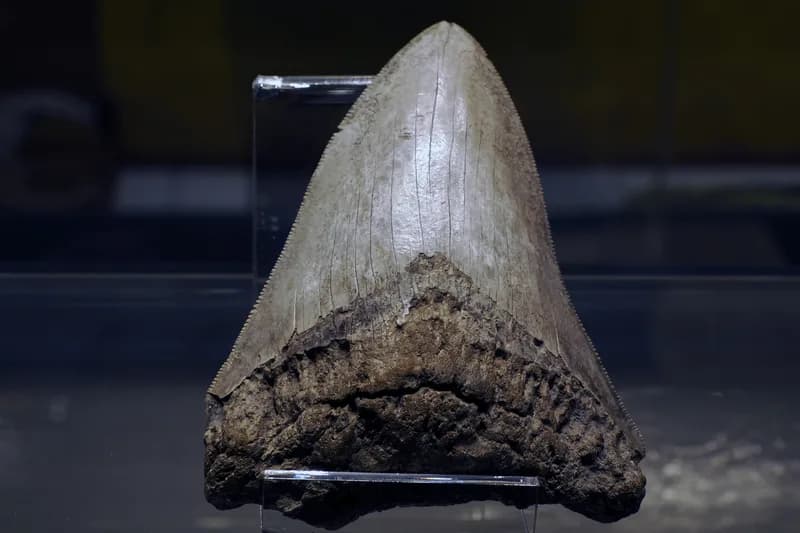
An 11-year-old from western Pennsylvania reached into a hole in a rock jetty at the Jersey Shore and pulled out a fossilised tooth from the largest predatory shark that ever lived. Bo Bowers found the megalodon tooth on August 11 at Sea Isle City, near Townsends Inlet, while hunting for seashells with his father. Two institutions later confirmed the identification.
The Bowers family, from Elizabeth Township in Allegheny County, Pennsylvania, was staying in Wildwood. Mike Bowers, 42, was pulling shells loose when he noticed a hole in one of the rocks and something wedged inside.
His own hand was too big for the crevice, so he called his son over. Bo worked the object loose. It measured about 4 inches, dark surfaced, with a jagged, chipped edge, and was heavier than either of them expected.
Pulled from a crevice at low tide
Mike Bowers told Fox Weather he had been shelling along the shoreline, exposed at low tide, when the opening in the rock caught his eye. He could see something inside but could not get his hand through the gap, so he called across the beach for Bo, whose smaller hand fitted.
As I pulled a shell out of the one rock, there was a hole in the rock. I looked down, and I was just astonished, but I couldn't fit my hand in there. So, of course, I'm screaming like a crazy man for my son Bo to come running over because of his small hand.
Bo told NBC10 he was shocked and excited at the same time. Neither he nor his father knew what they had, only that it was unusually heavy and unlike any shell on the beach.
On the drive home the family stopped at the New Jersey State Museum in Trenton, where staff took them to the fossil lab and examined the specimen. Dana Ehret, the museum's curator of natural history, said such teeth "are highly uncommon in New Jersey because we do not have the right aged sediments preserved at or near the surface," and called the Bowers tooth "in extraordinary good condition for a tooth from New Jersey." Mike Bowers said the family was told it could keep the fossil because it was found on a public beach.
Confirmed at two institutions
The family also took the tooth to the Cape May Whale Watch and Research Center, which identified it as an Otodus megalodon. Daniel Iovino, a naturalist at the centre, said there are "only a handful of recorded findings of Megalodon teeth off of New Jersey's coastline."
The tooth carries a visible chip at one end. Mike Bowers said he was told the damage probably came from the shark biting into bone. No researcher has put that on the record, and it remains an inference about a single specimen.
Most megalodon teeth run about 4 to 5 inches. The largest known example is close to 18 centimetres, or about 7 inches, according to the Natural History Museum in London. The condition of the Bowers tooth, rather than its size, drew the strongest reaction.
Matt Remuzzi, a captain and co-owner of the Cape May Whale Watch and Research Center, said the specimen stood out among everything he had handled. The centre called it a once in a lifetime find.
It is actually the best condition Megalodon tooth I've ever seen. It was pretty incredible.
Mike Bowers told Fox News Digital the family "definitely did not expect to find something of that stature." He said the weight surprised him as much as the age.
How the tooth reached the jetty
How a fossil that old came to sit in a jetty rock is unresolved. The U.S. Army Corps of Engineers pumped 479,000 cubic yards of dredged sand onto Sea Isle City beaches between June 14 and July 13, drawing from borrow areas including one about three miles offshore. Steve Nagiewicz, an adjunct professor of marine science at Stockton University, said the work may have resulted in the tooth ending up on land. NBC10 reported that experts were speculating.
That explanation sits awkwardly with where the tooth was found, wedged inside a hole in a rock rather than loose in sand. Cape May County's bedrock is Miocene marine sediment, but Sea Isle City itself is a Holocene barrier island, so the fossil did not erode out of local rock where it lay.
- Otodus megalodon was the largest predatory shark in Earth's history.
- Tooth-based estimates put the largest individuals at 50 to 60 feet long.
- A 2025 paper in Palaeontologia Electronica proposed, as a working hypothesis, a maximum of about 80 feet.
- The species went extinct about 3.6 million years ago.
The family plans to keep the tooth. Bo starts sixth grade this month.
A second find, in England
Bo Bowers is not the only child to have turned up a fossil on a beach this year.
An elephant tooth in Suffolk
Charlie Orchard-Lisle, 11, was walking on East Lane beach at Bawdsey in Suffolk, England, on May 24 when his family noticed a rock-like object at the edge of the water, about 4 inches wide. His mother, Eleanor Orchard-Lisle, said he had been talking about how much he liked elephants ten minutes earlier.
The family photographed the object and posted the image to a Suffolk fossil group on Facebook. It reached Adrian Lister, a palaeontologist at the Natural History Museum in London, who confirmed from the photograph that it was the upper left molar of an Anancus arvernensis, an extinct relative of modern elephants. The museum has issued no statement and Lister has not been quoted directly.
What the family said
Eleanor Orchard-Lisle said the object had a different feel to it and that she and her son noticed it at the same moment, half in and half out of the water.
It is quite incredible and I can't believe you can find something so old that existed 1.8 million years ago and then just rocks up on the beach.
She said the tooth may have been buried in the Red Crag cliff at Bawdsey and flushed out by erosion. No specialist has publicly dated the specimen, and the 1.8 million year figure comes from the family rather than from the museum. Anancus arvernensis was comparable in size to an African bush elephant, standing more than 8 feet at the shoulder and weighing 5 to 6 tonnes.
The Red Crag Formation, which forms the cliffs along that stretch of the Suffolk coast, is Pliocene, laid down roughly 2.5 million years ago. Suffolk is also rich in Pleistocene material, but that comes from younger deposits above it.
Other finds by children
Two other children have made notable finds this year. A six-year-old on a school trip in Gran, Norway, picked up the hilt of an iron sword protruding from a ploughed field in late April, dated to the late Merovingian or early Viking age. In May the Israel Antiquities Authority announced that Dor Wolynitz, 8, had found a fragment of a Roman-era statuette about 1,700 years old while hiking with his family in Makhtesh Ramon.
Both beach finds surfaced during ordinary outings and were identified by researchers from photographs or from a visit. Both now sit with the families who found them.
Sources
- Fox News: Megalodon tooth discovered on Jersey Shore beach by man and son in Sea Isle City
- NBC10 Philadelphia: Family finds megalodon tooth on Sea Isle City beach
- Tech Times: Jersey Shore Rock Hides Megalodon Tooth
- WSOC-TV: Family unearths intact megalodon tooth during trip to the Jersey Shore
- WSFA: Family finds megalodon tooth while visiting the beach
- Fox News: Boy, 11, finds 1.8 million-year-old elephant tooth on England beach
- East Anglian Daily Times: Ancient elephant tooth found at East Lane Bawdsey beach
- SWNS: 11-year-old boy finds 1.8 million year-old elephant tooth on beach