Inouye Solar Telescope finds plasma vortices that may heat the Sun's corona
Kelvin-Helmholtz swirls, predicted for decades, turn up everywhere along the edges of the Sun's magnetic regions.
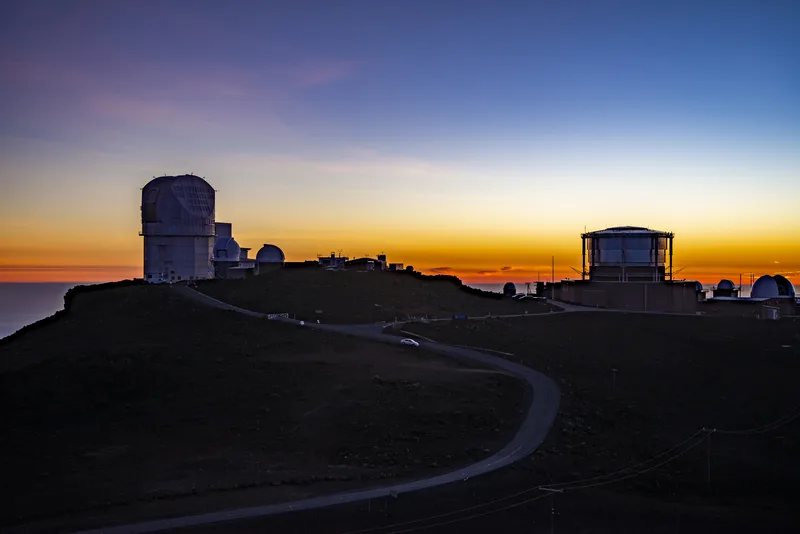
An international team of solar physicists has directly observed swirling, whirlpool-like vortices on the visible surface of the Sun for the first time, using the NSF Daniel K. Inouye Solar Telescope near the summit of Maui's Haleakalā. The vortices, identified as Kelvin-Helmholtz instabilities, appear at the edges of magnetic areas across the photosphere. The team's central claim is that they supply a missing source of magnetic diffusion; researchers also say they may contribute to heating the Sun's outer atmosphere, one of the oldest riddles in solar physics.
When I was sitting there with my colleagues and we looked at these images for the first time, we immediately recognized these Kelvin-Helmholtz patterns, and we were super excited right away.
Kelvin-Helmholtz instability forms where two fluids slide past each other at different speeds, creating a shear at their boundary that lets small ripples grow into wave-like or spiraling vortices. The pattern is familiar from clouds streaming over mountains and from the cloud bands of Jupiter and Saturn. On the Sun, theory had predicted it for the photosphere for years, but no instrument had resolved the fine detail needed to catch it in the act.
What the telescope actually saw
The highest-resolution image of the Sun's surface ever captured was taken at a wavelength of 416 nanometers by the Inouye Solar Telescope, the largest solar telescope in the world. It revealed deformed boundaries of magnetic elements and ultra-fine stripes, both signatures of Kelvin-Helmholtz instability. The team measured 47 vortices with wavelengths from 25 to 170 kilometers, clustering around 50 to 65 kilometers, with the smallest features about 20 kilometers or 12 miles across, close to the telescope's 19-kilometer resolution limit and minuscule against the vast scale of the Sun.
Time-lapse video from the telescope showed the swirls forming everywhere along the edges of magnetic regions, not as rare events but as a constant churn across the surface. The researchers matched the observations against numerical simulations of the Sun's surface magnetic field, and the simulated map confirmed that the process physically bends and deforms the boundaries of magnetic elements exactly as the images suggested.
We believe that the discovery of Kelvin-Helmholtz instability in the solar photosphere, backed up by analysis of numerical simulations, is a major step forward in our understanding of the dynamics and evolution of solar and stellar plasma, and will serve as a basis for future discoveries.
The study, titled 'Ubiquitous Kelvin-Helmholtz instabilities driving plasma mixing on the Sun,' was published in the journal Nature on August 5, 2026, with David Kuridze as lead author. The team drew on the National Solar Observatory, the NSF NCAR High Altitude Observatory, and the Max Planck Institute for Solar System Research in Germany. The telescope itself is built and operated by the National Solar Observatory on Maui.
The corona's million-degree problem
The Sun's corona, its faint outer atmosphere, runs between one and three million kelvin, while the visible surface below it sits at about 5,772 kelvin. Why the atmosphere burns hotter than the surface it surrounds has puzzled physicists for decades, since heat is not supposed to flow from a cooler region into a hotter one without some energy source driving it. Explaining that gap is the coronal heating problem.
Thomas Rimmele, chief technologist at the National Solar Observatory, said Kelvin-Helmholtz instability is likely one mechanism that contributes to heating the outer atmosphere and forms part of the solution to why stars carry a corona hotter than a million degrees. The microscopic vortices can twist and tangle magnetic field lines, potentially injecting energy upward from the surface into the corona above.
The swirling vortices of magnetic plasma could also be an effective source of free magnetic energy, the reservoir that powers major solar activity. That budget spans an enormous range, from tiny nano-flares to massive flares, jets, and coronal mass ejections, the explosive events that hurl charged particles across the solar system.
Those eruptions matter far beyond the Sun. Magnetic energy released in flares and coronal mass ejections can reach Earth, where it disturbs satellites, power grids, and other technology that modern life depends on. Understanding how that energy builds up, twists, and moves around on the Sun is a necessary step toward forecasting when and how forcefully it will be released.
A thin layer deep inside the Sun
A separate line of work has been chipping away at a different solar mystery, one buried far below the surface rather than sitting on top of it. Researchers at the University of California, Santa Cruz, working through NASA's COFFIES science centre, have been trying to explain the extreme thinness of the tachocline, the narrow layer dividing the Sun's inner radiative zone from its churning outer convective zone.
The tachocline sits where the radiative zone, which extends from about a quarter of the way out from the Sun's centre to about 70 percent of the radius, meets the convective zone, where hot gases swirl and spin at different speeds. It is where the seeds of solar flares and coronal mass ejections are thought to form, yet earlier models could never reproduce its razor-thin structure in a self-consistent way.
For decades, it was thought that the tachocline was a key component in driving the large-scale solar magnetic field. The picture that's emerging from our work is that the reverse might also be true: that the large-scale magnetic field might be a key reason why there's a tachocline to begin with.
Using tens of millions of processor hours on a NASA supercomputer, the Santa Cruz team built a model of the Sun's interior in which a tachocline forms of its own accord. Their simulations revealed a feedback loop earlier work had missed: the magnetic field produced in the convective zone helps keep the tachocline narrow, even as the tachocline in turn helps drive that field.
Earlier efforts, the team found, had leaned too heavily on viscosity, the sticky property that resists flow, which in reality plays a negligible role inside the Sun. Emphasizing radiative spreading instead let a tachocline emerge on its own. The layer was first detected in the late 1980s through helioseismology, which reads ripples inside the Sun much as seismologists read earthquakes to map the Earth. The follow-up findings appeared in The Astrophysical Journal in July 2026.
Cosmic dust enters the corona equation
Adding another variable to the coronal heating problem, a doctoral researcher at the University of Alabama in Huntsville reported in June 2026 that tiny charged dust grains near the Sun may shape how energy moves through the corona. Using data from NASA's Parker Solar Probe, the first spacecraft to fly through the solar corona, in April 2021, the study found that dust adds inertia that slows kinetic Alfvén waves, a leading candidate for carrying energy from the surface upward, letting that energy travel further before it dissipates.
Dust had long been assumed to be largely irrelevant so close to the Sun. The work, by Syed Ayaz of the university's Center for Space Plasma and Aeronomic Research and published in The Astrophysical Journal, suggests interplanetary dust can modulate those waves in ways prior theoretical models never accounted for. Parker's FIELDS instrument suite, which measures electric and magnetic fields, plasma waves, and radio emissions, supplied the measurements.
A switch-off signal for solar storms
Forecasting is where much of this points. Sandra Chapman, a professor at the University of Warwick, has set out a technique that could indicate the strength of the Sun's next activity cycle up to seven years before it peaks. It counts the sunspots present at a newly identified switch-off stage partway through the 11-year cycle. The work was presented at a conference this summer and has not yet been through peer review.
The switch-off is a phase nobody had picked out before, a point at which the distribution of sunspot activity shifts in a distinct way. Count the spots there, Chapman argues, and you can estimate how fierce the coming maximum will be. Existing methods wait for solar minimum, and even then the peak can only be confirmed six or seven months after it has passed, because the sunspot count is smoothed over 13 months. Cycle 25's maximum was fixed, retrospectively, at October 2024.
Why the timing matters for Earth
Solar storms are not an abstract threat. Intense periods of activity can knock out power grids, disrupt GPS signals, endanger astronauts, and damage or destroy satellites in orbit. Space weather also bears on astronaut safety and global navigation systems, which is why extra lead time on a coming solar maximum carries real, practical weight for operators on the ground and in orbit alike.
The resolution behind those swirls is what made the discovery possible. Features at these scales, down to about 20 kilometers, had never been resolved clearly enough to confirm the instability in the photosphere, even though the same physics had already been seen on Earth, in planetary atmospheres, in the interaction of the solar wind with planetary magnetospheres, and even in the Sun's own corona.
The findings do not stand alone. Solar physicists describe the tachocline work, the Kelvin-Helmholtz discovery, the dust study, and the switch-off signal as pieces of the same larger effort to understand how the Sun generates, stores, and eventually releases its magnetic energy, the engine that drives space weather throughout the solar system.
Kelvin-Helmholtz instability itself is not new to physics. Since Lord Kelvin and Hermann von Helmholtz first described it around 1870, it has turned up in fluid dynamics, meteorology, oceanography, and astrophysics, from ocean waves to the banded clouds of the gas giants and the boundary where the solar wind meets planetary magnetospheres.
What comes next
The Inouye team frames the observation as a foundation rather than a conclusion, a basis for future discoveries about how solar and stellar plasma behaves. The switch-off forecasting method still needs validation across multiple solar cycles before it can be trusted, and the coronal heating problem remains open. What has changed is that several long-standing pieces of the Sun's puzzle now have data and simulations pointing the same direction.
Sources
- NSF Inouye Solar Telescope Enables Major Discovery of a Hidden Solar Process
- Inouye Telescope Captures Countless Vortices on Sun's Surface at Highest Resolution
- These Are the Sharpest Images Ever Taken of the Sun, and They Might Solve a Decades-Old Mystery
- Inouye Solar Telescope Discovers Hidden Plasma Vortices on Sun
- UC Santa Cruz Researchers at NASA COFFIES Science Center Make Breakthrough on Solar Enigma
- Cosmic Dust Could Play Key Role in Cracking Long-Standing Mystery of Solar Corona Heating
- A Hidden 'Switch-Off' Signal Could Predict Solar Storms Seven Years Early