GJ 523b, a rocky mega-Earth, defies planet formation models
The Wisconsin-led team measured a world 2.55 times Earth's width but 23.5 times its mass, with almost no atmosphere.
Astronomers have identified an exoplanet that packs 23.5 times Earth's mass into a body only 2.55 times as wide, a density so high that standard theories of planet formation struggle to account for it. The world, named GJ 523b, is predominantly rocky and appears to hold almost no atmosphere, according to the University of Wisconsin-Madison team that characterized it.
| Measurement | GJ 523b |
|---|---|
| Mass | 23.5 times Earth's mass |
| Radius | 2.55 times Earth's radius |
| Bulk density | 7.8 grams per cubic centimeter |
| Orbital period | 17.75 days |
| System age | About 169 million years |
| Distance from Earth | 87 light-years |
| Minimum orbital tilt | 71.4 degrees |
That density, about 40 percent greater than Earth's, is the crux of the puzzle. A planet carrying 23.5 Earth masses sits well above the point where planetary science expects a growing rocky core to sweep up hydrogen and helium and swell into a gas-shrouded world. GJ 523b crossed that mass threshold and either never grew the envelope or grew one and lost it. The result is a body with the dimensions of one class of planet and the interior of another.
A world that models did not predict
The core accretion model holds that once a rocky core reaches roughly 10 to 20 Earth masses, it triggers runaway gas accretion and rapidly pulls in a thick gaseous envelope. Jupiter, at about 318 Earth masses, and Saturn, at about 95, both followed that path and became gas giants. GJ 523b is heavy enough to have done the same. It did not.
Its radius places it among the sub-Neptunes, a class that normally carries deep layers of hydrogen, helium and other volatile material. Its mass and density belong to a different kind of object entirely. The simplest reading, the researchers say, is that the planet is mostly rock and metal with remarkably little of the light gas a world that heavy would usually collect.
GJ 523b orbits GJ 523, a mid-K orange dwarf about 26.6 parsecs, or 87 light-years, from Earth. It completes one orbit every 17.75 days, close enough to its star that its zero-albedo equilibrium temperature is estimated at 538 kelvin. The star itself rotates once about every 5.6 days.
The system is young, which sharpens the problem. Gyrochronological analysis of GJ 523 and four stars that move with it through the galaxy puts the age at about 169 million years. That leaves little time for an enormous primordial atmosphere to have drifted away, so the absence of one is harder to explain than it would be around an ancient star.
No instrument has looked inside the planet, and its exact composition remains model-dependent. What the measurements establish firmly is the mass and the radius, and together they mark GJ 523b as a dense outlier well off the tracks that most sub-Neptune-sized planets follow.
How the planet was found
The detection began with NASA's Transiting Exoplanet Survey Satellite, which watched GJ 523 and recorded a repeating dip in its brightness each time the planet crossed the star's face. TESS has flagged more than 8,000 candidate planets since it launched. About 900 have been confirmed as real worlds and some 2,100 ruled out, on the mission's August 2026 count. GJ 523b started as one of those candidates.
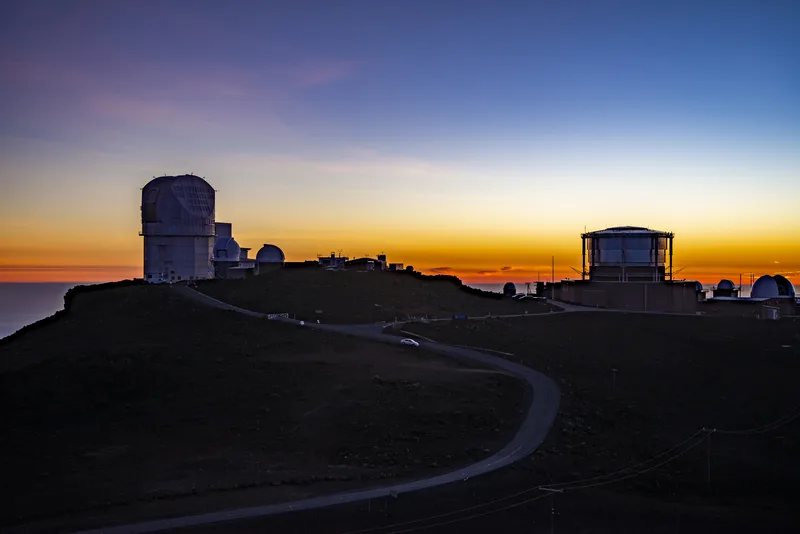
Max Kroft, a graduate student at the University of Wisconsin-Madison and the lead author of the study, followed up with a high-resolution spectrograph on the WIYN telescope at Kitt Peak National Observatory in Arizona. Thirty radial-velocity measurements taken with the NEID instrument between February and July 2025 confirmed that the signal came from a planet and pinned down its mass.
A bigger planet makes a bigger dip, so we get an idea of the size, and based on how often that dip happens, we get the distance of its orbit, and we can use that to estimate the temperature of the exoplanet.
The team combined the spectrograph data with the TESS light curve and high-resolution imaging from Gemini North and Palomar to constrain the planet's density and how much atmosphere it retains. NEID is a stabilized, high-resolution spectrograph spanning the red-optical range, and the 30 measurements each used 600-second exposures. GJ 523b is the first exoplanet discovered and cataloged by the Wisconsin Center for Origins Research, a collaboration of seven UW-Madison departments that launched in 2024.
The missing atmosphere and a tilted orbit
GJ 523b is large enough that astronomers would expect it to hold a thick gaseous envelope, yet its high density points to very little atmosphere. Kroft called the planet's formation "a real curveball."
Three explanations dominate the effort to account for the missing gas. In the first, a giant impact, a collision with another large body blasted the gas into space and left behind a super-dense rocky remnant. In the second, the planet migrated inward on a stretched orbit and tidal forces stripped the envelope away. In the third, gas accretion began too late in the disk's life for a thick envelope ever to form. The team considers photoevaporation, in which stellar radiation boils an early atmosphere off, unlikely here.
Each scenario would leave a planet that looks much like GJ 523b, a heavy core with little or no gas around it. With the data now in hand, the researchers say there is not yet enough information about the system to determine which, if any, actually occurred.
The planet's orbit deepens the mystery. GJ 523b travels on a path tilted at least 71.4 degrees from its star's equator, close to a polar orbit that would carry it over the star's poles rather than around its middle. That figure was inferred from a stellar inclination of about 17.6 degrees.
Such a steep angle usually signals a turbulent past. Secular resonance with a tilted protoplanetary disk could have moved the planet onto its polar track, a mechanism proposed in a separate 2026 study. A heavy outer companion could also have tipped it, though the team calls that less likely and has found none; speckle imaging shows GJ 523 to be a single star. A Rossiter-McLaughlin observation, which tracks how a star's spectral lines distort during a transit, could measure the orbit's angle and test whether it is truly polar or even running backward.
Defining a new class of planet
The researchers used GJ 523b to give the loose term mega-Earth a formal meaning. People have applied the phrase for more than a decade without a clear definition behind it. In the paper the team defines the class as planets with a radius of at least 2.1 Earth radii and a density of 5.5 grams per cubic centimeter or higher.
Plotting known exoplanets on a radius-density diagram, the team found that most fall into recognizable groups of super-Earths, sub-Neptunes and Neptune-like planets. A fourth cluster holds the high-density outliers, the mega-Earths, with GJ 523b sitting among them and other worlds that refuse to fit the main tracks.
Characterizing the planet drew on more than astronomers. The work required geologists who study how iron and rock behave at pressures no laboratory on Earth can reach, and atmospheric scientists who could judge how much of the measured material is rock and how much might be gas.
GJ 523b is dense enough, and well enough measured, to anchor the new category, the first planet to tie the mega-Earth label to specific numbers rather than a loose impression carried in the literature for years.
People have been using the phrase Mega-Earth for more than a decade, but we've never had a planet that let us say concretely what one is.
The classification stands on firm measurements while the history behind it stays open. The mass, the radius and the density are well determined. The formation route, the fate of any early atmosphere and the origin of the tilted orbit are not.
What comes next for GJ 523b
The study, led by Kroft with 20 co-authors from institutions including NASA Ames Research Center, the Center for Astrophysics at Harvard and Smithsonian, the NASA Exoplanet Science Institute at Caltech, Smith College and Penn State, was submitted to The Astronomical Journal on March 25, 2026. It is posted as a preprint on arXiv and has not yet completed peer review.
Beyond this one world, the find bears on where the threshold for runaway gas accretion actually sits and how many dense, rocky planets larger than Earth may be hiding among the thousands of candidates still awaiting confirmation. GJ 523b shows that a planet can grow heavy enough to become a gas giant and, for reasons not yet understood, remain mostly rock. Settling why will take closer study of the star and its lone known planet.
Sources
- GJ 523b is a Massive, 170 Myr-old Mega-Earth, Likely on a Polar Orbit (arXiv preprint)
- phys.org: Mega-Earth GJ 523b is 23 times as massive as our planet, but only 2.5 times as wide
- space.com: Astronomers discover a giant, rocky mega-Earth 23 times more massive than our planet
- spacedaily.com: At 23.5 times Earth's mass, GJ 523b is a dense rocky mega-Earth
- newsnationnow.com: Mega-Earth GJ 523b identified: Researchers at UW-Madison question how it formed