Dark bordered beauty moth rediscovered in Northumberland after 74 years
Butterfly Conservation found the custard-and-chocolate-coloured species at the National Trust's Wallington Estate, its second surviving English colony.
A hidden population of the dark bordered beauty, one of England's rarest moths, has been found at the National Trust's Wallington Estate in Northumberland, a site where the species had not been recorded since 1952. Dr Dave Wainwright, Head of Conservation (England) at Butterfly Conservation, located the first moth within minutes of arriving on July 16, 2026. Butterfly Conservation and the National Trust announced the find on August 14.
It only took 10 minutes to find the first one, then we all started picking them up quite regularly.
The rediscovery, made 74 years after the moth was last logged at the estate, gives conservationists a second surviving colony in England. Until now the only English population sat at Strensall Common in North Yorkshire, where numbers have collapsed under drought, wildfire and the loss of the plants its caterpillars need. The Northumberland find, on very different ground, has shifted the odds for a species that had looked close to vanishing from the country.
A colony lost since 1952
Wainwright has hunted for new English colonies since he joined Butterfly Conservation in 2004, both during work hours and in his own time. That year he visited Wallington, where the dark bordered beauty had been recorded before but not since 1952, and came away empty-handed. Two decades later the site had changed, and this time he arrived to find the moths waiting.
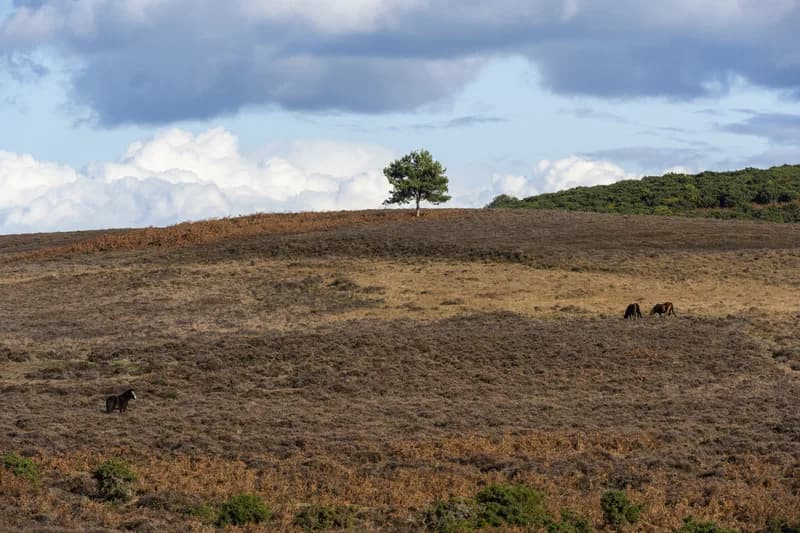
The estate's habitat had been transformed by the National Trust and its tenant farmer through nature-friendly farming, with grazing reduced in key areas and peatland restored. Those changes may have helped the moth return or quietly persist. The visit was arranged with project officer Charlotte Rankin and National Trust rangers.
The find changes how experts picture suitable ground for the species. Wainwright described an overwhelming sense of relief on tracking down a second English colony. He said conservationists had held very fixed ideas of good habitat based on Strensall, yet the Wallington site looks markedly different, and the discovery opens a new front in knowledge of the moth in England.
Why the species is so fragile
The dark bordered beauty was once widespread across northern England and Scotland. Habitat loss has stripped it back to two small areas on Deeside and Speyside in Scotland, plus the two English sites now confirmed. In Northumberland it was also once recorded at Newham Bog, where it is considered extinct.
A single vulnerability runs through the moth's biology. Its caterpillars will eat only two plants, aspen and creeping willow, so wherever those plants vanish the moth cannot breed. That dependence makes each surviving colony precarious and every new site valuable.
At Strensall Common, some 570 hectares of lowland heath about 10 kilometres north of York, the moth has been known since the 19th century, with records reaching back to 1894. Most of the land belongs to the Ministry of Defence and is used for military training. The Yorkshire Wildlife Trust manages a reserve in the north-east corner and Forestry England a smaller portion. The common ranks as the third most important site for Lepidoptera in Yorkshire.
Numbers there have fallen by more than 90 percent since recording began, with as few as 50 to 100 adults now thought to survive. A University of York study tracking the population from 2007 to 2014 found adult moths declining by 30 to 35 percent a year, a rate its authors called rapid and severe.
Fire, drought and grazing at Strensall
The Strensall decline traces back to creeping willow, the caterpillar's foodplant there. A fire in 2009 destroyed the most important area of those plants. Grazing by cattle and sheep, essential to stop trees and shrubs taking over the heath, has also wiped out willow, leaving fewer places for caterpillars to feed and for moths to lay their eggs in summer.
Climate change has sharpened the threat. Drought and wildfire have become more common, and on May 20, 2025 a blaze burned about a square kilometre of the reserve, which is managed jointly by Yorkshire Wildlife Trust and the Ministry of Defence, coming within about 600 metres of the moth's habitat. Numbers that reached the hundreds two decades ago barely made double figures in the 2025 season, a fall that left the last known English colony hanging by a thread until the Wallington news.
- Deeside, Scotland, one of two small surviving areas north of the border
- Speyside, Scotland, the other remaining Scottish site
- Strensall Common, North Yorkshire, where the population is collapsing
- Wallington Estate, Northumberland, the newly confirmed colony
The dark bordered beauty is a species of principal importance in England, the designation that replaced the old Biodiversity Action Plan listing. Moths are treated as sensitive indicators of environmental change, quick to respond when their surroundings alter.
Before 2007, researchers estimated between 500 and 1,000 adults spread widely across Strensall Common. The moth favours sheltered spots at the edges of woodland, where creeping willow can grow, and those pockets have shrunk as fire and grazing take their toll. Grazing itself is a paradox at the site, because cattle and sheep are needed to hold back trees and shrubs and keep the internationally important heath open.
Dr Terry Crawford, Honorary Fellow in the Department of Biology at the University of York, once described the moth as part of the natural history heritage of England and Yorkshire, and warned that losing Strensall would mean losing the species from England altogether. That was a decade ago. The Wallington find removes the danger he was describing without lifting any of the pressure on Strensall.
Shoring up the Yorkshire population
Butterfly Conservation is working with Yorkshire Wildlife Trust to manage the habitat at Strensall, and plans a captive breeding trial aimed at seeding new colonies in the country around York rather than at Strensall itself. A comparable release of 160 caterpillars has already been tried in the Cairngorms. The charity's short-term measures there have always centred on the foodplant.
Those measures centre on the willow itself. Teams have planted willows grown from local seed and fenced them off from sheep, hoping to increase both the number and size of the plants. Researchers plan to keep monitoring with volunteers and may adjust the grazing regime on the common. The Ministry of Defence said in 2024 that it was working through the Defence Infrastructure Organisation and with the University of York on fencing and monitoring.
The search that spanned a career
The Wallington moths turned up during a project backed by £300,000 from the Elgol Fund for Nature, which Butterfly Conservation received in 2025. Wainwright had told colleagues for years that the Northumberland and Cumbria border might still hold the species, and the estate proved him right after two decades of doubt.
The thing that's kept me going all these years is I always felt there was a chance of finding Dark Bordered Beauty on the Northumberland/Cumbria border. Now it feels like there could be other colonies out there waiting to be discovered which would be brilliant.
For Wainwright the rediscovery ranks among the highlights of his career. He has said the moth's return to Wallington opens the possibility that other overlooked sites hold colonies nobody has thought to check, because the estate looks nothing like the habitat experts were trained to expect.
A pattern seen beyond Britain
The story has a parallel across the Atlantic. In central Florida, Ryan St Laurent, an assistant professor at the University of Colorado Boulder and curator of entomology at its museum of natural history, rediscovered Cicinnus albarenicolus, a sack-bearer moth known from about 20 museum specimens and not collected since the 1960s. He found live specimens during nighttime fieldwork in the state's rare white-sand scrub in late 2025, using specialized light traps set out after dark, and published the result in April 2026.
St Laurent is an assistant professor of ecology and evolutionary biology and curator of entomology at the CU Museum of Natural History. He found three live female moths shortly after sunset over two nights near Cassia and Seminole State Forest, then took the females to collaborators at the University of Florida in Gainesville to attempt rearing offspring, which could reveal how the moth lives.
- The moth is the only member of its family known to be endemic to the United States
- It appears restricted to Florida scrub, of which about 10 percent of the original acreage remains
- Researchers do not yet know what its caterpillars feed on
- Its lifespan and sensitivity to habitat disturbance remain unknown
Both cases point to the same lesson. Species written off as gone can persist in small, isolated pockets, waiting on the right survey or the right change in habitat to surface again. St Laurent has said he had only ever seen his moth pinned in museum drawers before finding it alive, and only a handful of species in its genus occur in North America.
What comes next for the moth
Butterfly Conservation now has two English sites to protect rather than one, and a reason to widen the search. The Strensall population still needs urgent help, and the captive breeding trial and willow planting will test whether the Yorkshire colony can hold on, while the Wallington find suggests more of the species may yet be out there, on ground nobody has thought to survey.
Sources
- ca.news.yahoo.com: Hidden moth population found after 70 years
- northumberlandgazette.co.uk: Conservationist rediscovers rare moth colony after more than 70 years
- irishnews.com: Hidden population of rare moth discovered after conservationist's lifetime hunt
- yorkshirepost.co.uk: Rare moth only found in Yorkshire discovered at second site in north of England
- hexham-courant.co.uk: Rare moths discovered on Wallington Estate, Northumberland
- gov.uk: Work to save rare British moth from extinction in England
- PLOS ONE: Decline of a Rare Moth at Its Last Known English Site
- york.ac.uk: Rare moth in severe decline at its last English site
- newswise.com: A moth species believed extinct for decades has been rediscovered in Florida