Sri Lanka Revives 2022 Fuel Rationing as Iran War Chokes Supply
The government ordered a four-day work week after fuel prices rose about 25 percent in a single step in March.
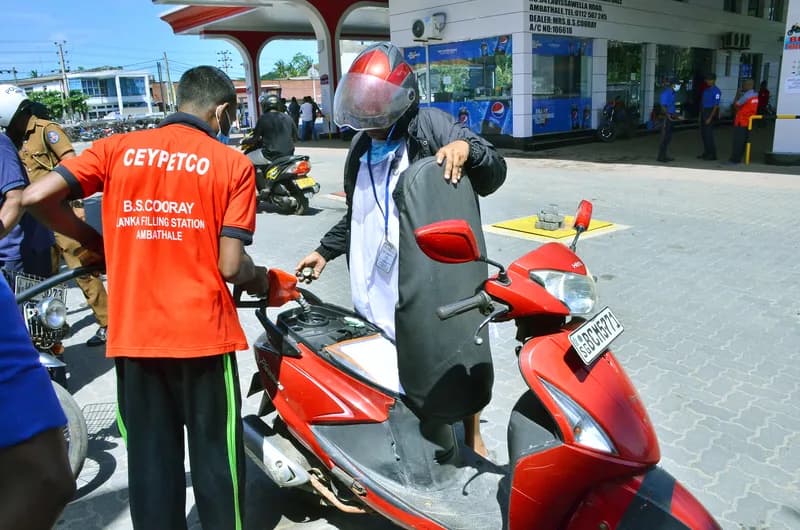
Sri Lanka has revived the fuel-rationing system it last used during its 2022 financial collapse, capping how much petrol and diesel drivers can buy as the war on Iran cuts off supply through the Strait of Hormuz. The government, at an emergency meeting chaired by President Anura Kumara Dissanayake, ordered a four-day work week and urged employers to bring back work-from-home arrangements where possible.
The government raised fuel prices by about 25 percent in a single step on 22 March 2026, taking the increase since the fighting began to between 26 and 30 percent. Regular petrol now sells for 398 rupees a litre, up from 317, while diesel climbed 79 rupees to 382.
Sri Lanka imports 60% of its energy, much of it routed through the strait, and holds about 25 days of fuel storage. For a nation of about 22 million people still climbing out of the 2022 meltdown, the timing is dangerous. Officials warned that a prolonged war could undermine the recovery.
A 54-kilometer chokepoint
The Strait of Hormuz is about 54 kilometers wide at its narrowest point, yet roughly 20 million barrels of crude and petroleum products move through it each day, about one-fifth of the world's oil consumption and about one-fifth of all seaborne liquefied natural gas. About 90% of Iran's oil exports pass through it. Commercial transits dropped from around 70 a day to near zero after fighting broke out on February 28, 2026, and had recovered to more than 80 a week by early August.
The war in the Middle East is creating a major energy crisis, including the largest supply disruption in the history of the global oil market.
Brent crude jumped 39% from its level on the last trading day before the conflict and briefly climbed above $110 a barrel, Deloitte reported as of 12 March 2026. The loss of up to 20 million barrels a day is roughly one-fifth of global flows. Iran, the country the strikes targeted, got no crude past the US blockade in May, down from just over 2.1 million barrels a day of total oil in February, its last full month before the war.
QatarEnergy halted liquefied natural gas production on March 2 and declared force majeure two days later, jolting global gas markets. At the peak of the disruption, the war was costing the world economy roughly $20 billion a day in lost output, on SolAbility tracking data.
The squeeze reaches the Global South
A stronger dollar has deepened the damage. As investors buy the greenback amid geopolitical uncertainty, currencies across the developing world have weakened, pushing import bills higher just as oil prices climb about 40%. The strain lands hardest on economies that already import most of their fuel and carry heavy public debt, with little cushion in their foreign reserves.
Pakistan imports about 85% of its crude oil, roughly 80% of it routed through Hormuz, and pumps only about 80,000 barrels a day, less than a fifth of what it consumes. Its current account deficit widens by roughly $1.5 billion to $2 billion for every $10 rise in oil prices, according to Ehsan Malik, former chief executive of the Pakistan Business Council. At $100 oil, he said, that gap could grow by $5 billion to $7 billion, enough to erase the $2 billion surplus it posted in the last fiscal year.
Every $10 rise in oil also adds about 0.5 to 0.6 percentage points to Pakistani inflation, on Malik's figures. Reza Baqir, the country's former central bank governor and now an adviser to governments in debt distress, said the conflict has hit vulnerable countries from almost every angle. Oil is up about 40%, import bills are climbing and remittances from Gulf workers are set to decline.
Bangladesh, which imports roughly 95% of its energy, faces the same squeeze. Indonesia entered the crisis with the rupiah near a record low, and the Philippine peso has since set successive record lows of its own, so every barrel they buy now costs more in local terms.
Which economies sit most exposed
The Center for Global Development, a research group in Washington, has set out which economies are most exposed, weighing fuel-import dependence, public debt and the ratio of reserves to imports. Its list stretches across three continents, and several of the countries on it lean heavily on money sent home by workers in the Gulf.
- Pakistan, which imports roughly 80% of its energy from the Gulf and produces less than a fifth of the crude it uses
- Bangladesh, which imports about 95% of its energy
- Sri Lanka, still climbing out of its 2022 default and routing most fuel through Hormuz
- Egypt and Jordan, exposed through fuel bills and slumping tourism
- Senegal, Angola, Ethiopia and Zambia, weighed down by debt and rising fuel costs
Egypt and Jordan carry an extra burden through tourism, where proximity to the fighting is already thinning visitor numbers, the IMF said. Beyond fuel, importers from Taiwan, Vietnam and Thailand to Kenya and Tunisia face pressure spanning energy, metals and grain as shipping routes narrow.
Pakistani authorities rushed out emergency fuel-conservation measures as the bills mounted. Across the region the response has looked much the same: cap the ration, restore the subsidy and stretch reserves while governments wait for the strait to reopen and freight premiums to ease.
Food and fertilizer costs climb
About a third of the world's fertilizer trade passes through the Strait of Hormuz, including urea made from liquefied natural gas. With LNG plants dark, Qatar halted output at the world's largest urea plant, raising alarm across global agriculture. The six Gulf Cooperation Council states import 97% of the sugar, 91% of the vegetable oils and 77% of the rice they consume, so the same shipping snarls that lifted fuel costs are now reaching the region's food.
Counting the global bill
The 2026 Global Peace Index puts the output the world is already losing to the conflict at $2.2 trillion a year, and estimates that a renewed, wider war could cost $3.5 trillion. Its most likely near-term scenario, an uneasy stalemate with the strait partly reopened but shipping premiums still high, would shave about $1.3 trillion, or 0.6%, off global output this year. The harshest case assumes the strait stays shut for six months or more and regional powers are pulled deeper into the fight.
The Peterson Institute for International Economics expects global growth to slow from 3.3% in 2025 to 3.0% in 2026 before edging up to 3.1% in 2027. The Institute for Economics and Peace puts the war's total drag anywhere from $590 billion to $3.5 trillion, as much as 3.15% of world output, depending on how long the fighting lasts.
The energy shock is the main channel to the rest of the world. Brent's spike rippled into natural gas, fertilizers and metals, tightening supply chains and lifting production costs, according to Deloitte. Stock markets fell and a global bond sell-off followed as investors braced for higher inflation, and expected interest-rate cuts were pushed back or, in some cases, reversed.
Gulf forecasts cut
The International Monetary Fund sharply cut its 2026 growth forecasts for the Middle East and North Africa in April, with the deepest downgrades falling on the Gulf gas and oil exporters. IEA Executive Director Fatih Birol has put damage at more than 80 energy facilities in the region, and Rystad Energy estimates repairs could cost $58 billion. The IMF sees a 7% cumulative output loss across the Gulf over five years, with effects lingering past a decade, on figures cited by the Stimson Center. The Fund cut the region again on 8 July, to 0.7% growth for 2026, without publishing country detail.
| Country | IMF 2026 growth projection |
|---|---|
| Qatar | -8.6% |
| Kuwait | -0.6% |
| Bahrain | -0.5% |
| UAE | +3.1% |
| Saudi Arabia | +3.1% |
| Oman | +3.5% |
Source: IMF, Regional Economic Outlook Update: Middle East and Central Asia, 16 April 2026, Table 1
Saudi Arabia signaled a retreat from its most ambitious giga projects and refocused on foreign investment, financial services and tourism. Its Public Investment Fund ended its funding of LIV Golf after the 2026 season and withdrew from a sponsorship deal with New York's Metropolitan Opera worth up to $200 million over eight years. Saudi bankruptcy filings jumped 91% to 141 cases in the first quarter, two-thirds of them by retail and construction firms seeking relief. Bahrain, Kuwait, Qatar and the UAE moved in late March and April to prop up local businesses and keep trade financing flowing.
Iran, where the war began, is in what analysts call freefall. The IMF expects its economy to shrink 6.1% in 2026, with inflation near 68.9%, and the rial has slid to about 1.32 million per U.S. dollar. Tehran has published no GDP data since 2024, and an internet blackout has cut off even its unreliable domestic figures.
Senior officials reportedly told President Masoud Pezeshkian that rebuilding could take more than a decade. The Foundation for Defense of Democracies put the daily cost of the blockade at about $435 million, with monthly inflation reaching 8.8% in May. Iran's leading financial daily, Donya-e-Eqtesad, had modeled a 123% inflation scenario for open conflict late last year, close to what unfolded. Recovery, the group argued, will require political change the Islamic Republic has resisted for 47 years.
Sources
- Al Jazeera: Sri Lanka Braces for New Economic Crisis as War on Iran Continues
- Al Jazeera: From Pakistan to Egypt, Iran War Drives Up Prices in the Global South
- CNBC: Iran's economy in charts: Hyperinflation and depreciating rial
- Vision of Humanity: The Hidden Price of the Iran War
- FDD: Iran's Economic Catastrophe
- Stimson Center: Iran Conflict Hits Foundations of Gulf Economies
- Deloitte Insights: Iran and Middle East Conflict Impacts Global Economy
- PIIE: Global Economy to Slow in 2026, Outlook Clouded by War