Thieves buy tickets, steal Queen Nazli's diamond necklace in Vienna
The Van Cleef & Arpels piece sold for $4.28 million at Sotheby's New York in 2015. One raider was armed.
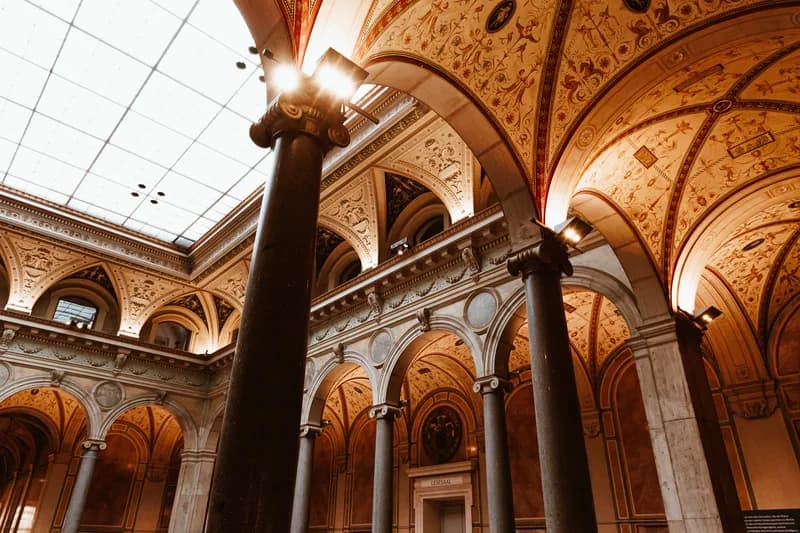
Two men bought tickets to Vienna's Museum of Applied Arts, smashed a glass display case with a hammer and walked out with a platinum necklace set with 673 diamonds, Austrian police said. The theft happened during the museum's regular opening hours on the afternoon of 27 August and has triggered a national and international manhunt for the pair.
The necklace, designed by Van Cleef & Arpels and set with more than 200 carats of diamonds, was commissioned for Egypt's former royal family and worn by Queen Nazli in 1939. It sold for $4.28 million at a Sotheby's auction in New York in December 2015, the auction house's records show. Vienna police have given no figure for what it is worth now.
Both suspects entered the museum as ordinary visitors at around 2 pm local time, police said. They did not wear masks and were clearly recorded on the museum's surveillance cameras before breaking the case in front of several witnesses and fleeing on foot towards the neighbouring Stadtpark, where police said their trail was lost. No one was injured among staff or the museum's guests, and the two escaped without being stopped.
A daylight raid in central Vienna
The pair moved through several exhibition halls before stopping at the display case at around 2 pm, according to police accounts. One of the two men carried a weapon that police described as probably real and said he displayed to clear his path but did not use. Using a hammer, they shattered the protective glass and grabbed the diamond-encrusted necklace in front of multiple visitors, then walked out of the building on foot.
Vienna police released photographs and descriptions of the two suspects as the search widened across the city. Both men were described as between 170 and 175 centimetres tall, of slim build, with dark hair and dark beards. Each wore black outer clothing and dark trainers with white soles. Surveillance cameras inside the museum captured clear footage of both men.
Numerous emergency personnel were deployed across central Vienna after the alarm was raised, and a police dog was used in the search, according to Austrian reporting. The Federal Criminal Police Office's cultural heritage investigation unit joined the inquiry, which is being led by the Vienna Regional Criminal Investigations Office.
Authorities believe the two suspects knew in advance exactly which item they intended to take, a sign that the raid was carefully targeted rather than opportunistic.
A necklace made for a queen
Queen Nazli commissioned the necklace, along with a matching tiara, for the 1939 wedding of her daughter, Princess Fawzia, to the Iranian Crown Prince Mohammad Reza Pahlavi, who later became the last Shah of Iran. The Art Deco piece, designed that same year, is crafted from platinum and holds 673 round and baguette-cut diamonds arranged in a sunburst pattern.
The necklace totals more than 200 carats in gemstones, according to figures released by police. Van Cleef & Arpels, the French house founded at Place Vendôme in Paris in 1906, describes the piece as a semi-circular draped motif, completed by a tiara wound with ribbons of platinum and diamonds.
On its website, Van Cleef & Arpels describes the stolen necklace as one of its signature achievements in white jewellery.
This monochrome necklace is an iconic example of the success of white diamond jewelry in the late 1930s.
The French company did not immediately comment on the theft. Following the abolition of Egypt's monarchy, Queen Nazli sold the necklace at a Sotheby's auction in November 1975, at the age of 81. The piece then stayed out of public view for four decades until it resurfaced at Sotheby's New York in 2015, where it sold for $4.28 million. The necklace went back on public display in Vienna on 10 June, this time at the MAK.
The costliest Vienna heist since the Saliera in 2003
The theft is the highest-value art heist in Vienna since Benvenuto Cellini's gold-and-enamel Saliera was stolen from the Kunsthistorisches Museum in 2003, according to The National. That celebrated Renaissance salt cellar, valued at €50 million, was recovered three years after it went missing.
Sotheby's put a pre-sale estimate of between $3.6 million and $4.6 million on the necklace before the 2015 auction. Its links to the Egyptian royal family have long shaped its value.
The necklace had been shown publicly only rarely. It went on display in Paris at the Muséum national d'Histoire naturelle in 2020, in a Van Cleef & Arpels exhibition that marked its first showing in France. It had been in Vienna since June.
The Kronen Zeitung reported that investigators are examining possible connections to an organised criminal group, though Austrian authorities have not formally confirmed any such link. Police said they believed the robbery was targeted rather than opportunistic, but declined to confirm whether it had been carried out to order.
Part of a Van Cleef & Arpels show
The necklace had been on display since 10 June as part of the museum's 'Glanzstücke' exhibition, a temporary show pairing about 500 objects. More than 300 came from Van Cleef & Arpels and about 200 from the MAK's own collection. The exhibition had been scheduled to run until 27 September.
Presented in partnership with the Parisian house, the show ran under the full title 'Glanzstücke: Van Cleef & Arpels High Jewellery x Masterpieces from the MAK Collection' at the museum on Vienna's Ringstrasse. It brought together loans from the maison and works drawn from the museum's own holdings.
The MAK confirmed the theft, and its general director, Lilli Hollein, said the museum's security concept had worked as planned and that protecting visitors came first because one of the raiders was armed. The museum closed the affected exhibition on the day of the theft and obscured the shattered display case, then reopened the show on 28 August in consultation with police. It declined to give further details while the investigation continued.
A wave of thefts across Europe's museums
The Vienna raid is the latest in a series of thefts at leading European museums. In the early hours of the same day, thieves in Spain raided the Treasure of Villena, one of Europe's greatest Bronze Age gold collections, taking most of the 50-plus mainly gold bracelets, bowls, bottles and other items on display at a museum in the country's southeast. Local reporting said that raid took under four minutes. The mayor of Villena, Fulgencio Cerdán, told reporters the thieves had left behind only a handful of the treasures.
We are totally devastated, I am still trembling.
The most prominent of the recent thefts came on 19 October 2025, when raiders broke into the Louvre in Paris in broad daylight and escaped in less than eight minutes with jewellery that prosecutors valued at €88 million, or about $102 million. The suspected thieves have since been arrested and charged, but none of the jewels have been recovered except a crown that was dropped as the group fled. The Louvre's director offered to resign after the theft, was refused, and left the post in February 2026.
Europol, the European Union's law enforcement agency, warned in a report published in August that criminals are increasingly going after precious metals, gemstones and Chinese cultural artefacts, which can be melted down or broken up and sold without leaving a trace. The report, 'Changing Tactics, Changing Targets: The Evolving Nature of Museum Heists,' says the profile of the thieves is shifting, with brute force replacing the guile of earlier decades and many robbers coming from backgrounds in other types of crime.
The search for the two suspects
The Vienna Regional Criminal Investigations Office has opened both a national and international search for the two men, according to reporting from the Austrian capital. Police have circulated their images widely and are appealing for information about the pair's movements after they left the museum. No arrests had been reported by 28 August, and investigators were still working from the clear surveillance footage recorded inside the museum.
The MAK said it could not provide further information at this stage of the inquiry. After a run of thefts in France, the French culture ministry announced a national museum security plan at the end of July 2026, including withdrawing high-risk items from display cases until stronger protection could be arranged.
Recovery in these cases is far from guaranteed. Cellini's Saliera, valued at €50 million, was one of the rare successes, turning up three years after it was taken in Vienna in 2003. German police recovered items from Dresden's Green Vault, insured for €116 million when stolen in November 2019, in 2022. Other pieces vanish for good: authorities believe the 100kg Big Maple Leaf gold coin, worth €3.75 million and taken from Berlin's Bode Museum in 2017, was melted down.
The 'Glanzstücke' exhibition, which had been due to close on 27 September, was shut on the day of the theft and reopened on 28 August, and the rest of the museum stayed open throughout. Van Cleef & Arpels had not responded to a request for comment from the AFP news agency. Police have given no figure for the necklace's current value.
Sources
- The National: Necklace made for Egyptian queen stolen in Vienna heist
- Euronews: Thieves buy tickets before plundering necklace worth millions from Vienna museum
- CBS News: Thieves buy tickets before plundering necklace from Vienna museum
- Knews: Armed robbery at Vienna museum, high-value Van Cleef & Arpels necklace stolen
- Pollar News: Thieves steal Queen Nazli's $4.3 million diamond necklace in Vienna museum heist
- UA News: A necklace set with 673 diamonds was stolen from a museum in Vienna
- US Muslims (Anadolu Agency): Diamond necklace linked to Egyptian royal family stolen from Vienna museum
- Anadolu Agency: Diamond necklace linked to Egyptian royal family stolen from Vienna museum