Putin makes first visit to disputed Kuril Islands, Japan protests
The Russian leader toured a fish plant, hospital and school on Iturup after Pacific Fleet drills involving 13,000 troops.
Russian President Vladimir Putin set foot on the Kuril Islands for the first time on Thursday, August 13, 2026, traveling to Iturup at the southern end of a Pacific chain that Japan also claims. The trip drew a formal diplomatic protest from Tokyo and marked the first time in a presidency and premiership spanning more than two decades that he personally reached the disputed archipelago.
On the island, which Japan calls Etorofu, Putin toured a fish plant, a hospital and a school, spoke briefly with local residents and met the governor of Russia's Sakhalin region, Valery Limarenko, according to Russian state media. The Kremlin posted a video of the visit.
Japanese Foreign Minister Toshimitsu Motegi said his government 'strongly protests' the visit and summoned Russia's ambassador, Nikolay Nozdrev, to the Foreign Ministry in Tokyo. Prime Minister Sanae Takaichi told reporters the trip offends the sentiments of the Japanese people and is absolutely unacceptable. Both officials returned to the same argument, that the islands belong to Japan and that Russia has no rightful claim to them.
What Putin did on Iturup
Putin visited the Yasny fish-processing complex at Kitovoye village on Iturup, where local officials gave him caviar, Russian media reported. He also stopped at a secondary school in Kurilsk named after the Hero of Russia Eduard Norpolov, looked in on a hospital, and spoke briefly with local residents. The itinerary matched what a Russian leader might do in any far-flung region, and from Tokyo's perspective that ordinariness was the point, a calculated demonstration that Moscow governs the islands as its own.
The trip was Putin's first to the islands, the state news agency TASS confirmed, capping a swing through several regions of Siberia and the Far East. Successive Russian leaders have guarded the archipelago closely, but no head of state had set foot there until Thursday. Tokyo has never accepted the territory as Moscow's, and it treated the president's presence as a direct challenge to Japan's decades-old claim.
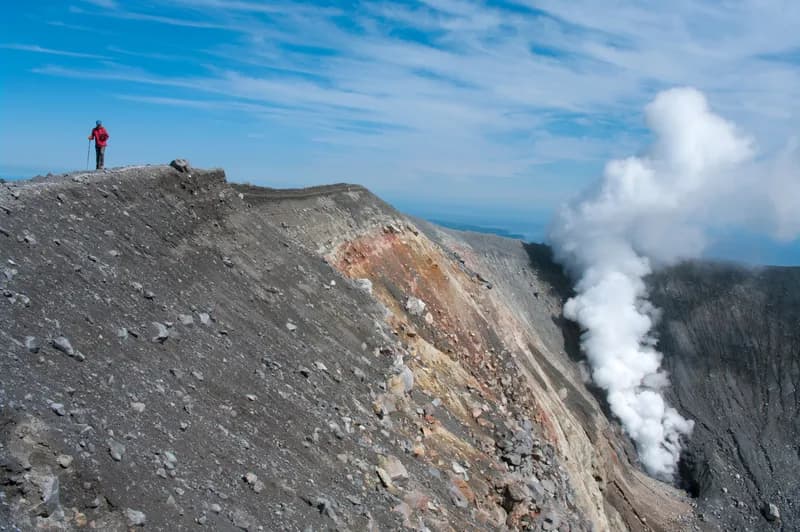
Iturup sits about 90 miles northeast of Hokkaido and is the largest and northernmost of the four disputed islands, ahead of Kunashir, Shikotan and the Habomai group. It anchors the southern end of a volcanic archipelago that runs in a broad arc from Russia's Kamchatka peninsula down towards Hokkaido, Japan's main northern island. Japan refers to the four islands collectively as the Northern Territories, while Russia counts them among the Kurils and administers them from the Sakhalin region.
The last senior Russian official to visit was Prime Minister Mikhail Mishustin in 2021, and that trip too drew a protest from Japan. Putin's arrival lifted the confrontation to a higher level by placing the head of state himself on contested ground. Russian forces have held the chain since the Soviet era, and Moscow has enlarged its garrison there over the years.
Tokyo's protest and Moscow's reply
Motegi laid out Japan's position in a statement and in a post on X. 'The Northern Territories, including Etorofu (Iturup) Island, are Japan's inherent territory both historically and from the perspective of international law,' he said, using the Japanese name for the island. He then summoned the Russian envoy to the ministry to press the objection face to face, according to Japan's Ministry of Foreign Affairs.
The Northern Territories, including Etorofu Island, are Japan's inherent territory both historically and from the perspective of international law.
Takaichi went further, saying the visit made it more difficult to restore relations in the medium to long term. She said the trip wounds the feelings of the Japanese people and hardens anti-Russian sentiment across the country, language that signaled little appetite in Tokyo for any near-term thaw with Moscow. Her remarks, delivered to reporters, matched the tone of the formal protest lodged by her foreign minister.
The Russian Embassy in Japan called Tokyo's protest 'unfounded.' It said Nozdrev had explained that the southern Kuril Islands are an integral part of the Russian Federation and became part of it following World War II on legitimate international grounds. The exchange left the two capitals restating claims that have not converged in 80 years, each citing the same war and reaching opposite conclusions.
A dispute rooted in 1945
The Soviet Union seized the islands in the final days of World War II and has kept a military presence there ever since. The two countries have never signed a peace treaty formally ending their wartime hostilities, and decades of diplomatic efforts have produced no visible settlement. Japan calls the four southernmost islands the Northern Territories, while Russia counts them as part of its far eastern Sakhalin province and treats their status as long since resolved.
| Date | Event |
|---|---|
| 1941 | Japan and the Soviet Union sign a neutrality pact |
| 1945 | The Soviet Union seizes the Kuril Islands as World War II ends |
| 2021 | Russian Prime Minister Mikhail Mishustin visits Iturup, drawing a protest |
| April 16, 2025 | Russia restricts sea navigation for foreign ships near the southern Kurils |
| August 13, 2026 | Putin makes his first visit to Iturup |
Source: Kremlin statements, Japan Ministry of Foreign Affairs, and AP and Moscow Times reporting
Russia grounds its claim in the postwar settlement, and points to the 1945 Yalta Agreement, reached months before the war ended, as having fixed the map. Putin, speaking aboard a warship on Wednesday, said the current status of the islands 'is enshrined in international documents as a reality that arose following the outcome of World War II.' He did not name Yalta, and presented the outcome as settled fact and beyond renegotiation.
Japan rejects that reading. Tokyo argues that Yalta contained only a non-binding recommendation, that Japan was not a party to it, and that the Soviet invasion in 1945 breached the neutrality pact the two sides had signed in 1941. That legal gap has anchored Japan's claim to the islands for eight decades, and no Japanese government has moved off it.
Naval drills preceded the trip
Before reaching Iturup, Putin stopped on Sakhalin Island to attend the final stage of drills by Russia's Pacific Fleet in waters off Sakhalin. He was aboard the missile cruiser Varyag alongside the fleet's commander, Admiral Viktor Liina, as warships maneuvered in nearby waters. He then held a meeting on ensuring the security of Russia's eastern borders, the state news agency RIA Novosti reported.
Russia's Defense Ministry said on August 5 that the exercises near Sakhalin would involve dozens of warships and aircraft and more than 13,000 servicemen. The tour capped days of travel that had taken Putin through several regions of Siberia and the Far East, and the naval display underscored the military weight Moscow keeps in the waters off Japan.
Tokyo has said Russia introduced restrictions on sea navigation for foreign military and civilian ships around the southern Kuril Islands starting April 16, tightening its grip on the waters around the disputed chain. The islands gained strategic value during the Cold War, when they served as air and sea bases as the Soviet Union confronted the United States and its closest Pacific ally, Japan.
Relations frozen since the Ukraine invasion
Ties between Tokyo and Moscow have worsened sharply since Russia's full-scale invasion of Ukraine in February 2022. Japan joined other Group of Seven countries in sanctioning Russia and has sent money and non-lethal defense aid to Kyiv. Putin has described that turn as a rupture in what had been a constructive relationship built up over years of contact between the two governments.
As relations with Japan cooled, Moscow's ties with China and North Korea warmed, giving Putin room to treat Tokyo's objections as background noise. The two neighbors carry a long history of rivalry, having fought a war in 1904 and 1905, long before the island dispute took its modern shape.
Putin points back at Japan
Putin has cast the sanctions as the reason for the freeze. Speaking on Wednesday, he called Japan's measures 'unprovoked' and argued that Tokyo, not Moscow, was the party pressing territorial claims. He rejected the idea that Russia posed any threat to its neighbor and turned the accusation back on Japan, portraying his country as the aggrieved party in the standoff.
Japan has identified Russia as a main source of threats. I would like to point out that we are not threatening Japan. On the contrary, it has territorial claims against our country.
He also left the door slightly open, saying Russia 'was prepared to seek a solution with the goal of concluding a peace treaty with Japan.' Putin praised former Prime Minister Shinzo Abe, calling him the tragically deceased leader who did much to bring the two countries closer together and to align their positions before relations soured.
Moscow has framed the president's movements as beyond negotiation. His travels, the Kremlin's account holds, are sovereign decisions of the Russian leadership and cannot be subject to discussion with foreign states, a line that leaves no space for Japanese input.
Russia administers the islands as part of its far eastern Sakhalin province and has steadily built up its forces there over the years, in moves that appeared to underscore its firm stance in the dispute. That buildup has run alongside the diplomacy for decades without ever producing a treaty or narrowing the rival claims, and Thursday's visit fit the same pattern of asserting control on the ground.
What comes next
No new talks are scheduled, and both governments have restated positions that have not moved in decades. Takaichi's warning that the visit set back any recovery of relations, set against Moscow's insistence that the matter is closed, leaves the oldest territorial dispute between the two neighbors exactly where it has sat since 1945. For now, the protest in Tokyo and the caviar on Iturup stand as the only movement in a standoff that shows no sign of ending.
Sources
- washingtonpost.com: Putin pays his first visit to Pacific island chain claimed by Japan, drawing a protest from Tokyo
- euronews.com: Japan slams Putin following first visit to disputed Kuril islands
- themoscowtimes.com: Putin Makes First Visit to Disputed Kuril Islands Amid Protests From Japan
- cnn.com: Putin pays his first visit to Pacific island chain claimed by Japan, drawing a protest from Tokyo
- aljazeera.com: Japan protests as Russia's Putin visits disputed Kuril Islands
- upi.com: Tokyo condemns visit by Vladimir Putin to disputed Kuril Islands
- npr.org: Vladimir Putin's first visit to disputed Pacific islands draws Tokyo protest
- washingtontimes.com: Putin's first trip to the Pacific island chain claimed by Japan draws a protest from Tokyo