Europe's 2026 heat linked to as many as 25,000 deaths
Western Europe logged its hottest June on record at 20.74 degrees Celsius as wildfires burned more than 1.23 million acres.
Western Europe recorded its hottest June and July on record in 2026, a stretch of extreme heat that the European Union's Joint Research Centre says has coincided with tens of thousands of excess deaths across the continent. In an announcement on August 12 the Centre cited World Health Organization figures of more than 10,000 excess deaths in just five countries, and a Bloomberg compilation that put the continent-wide toll at 25,000. Both figures are counts the Centre is relaying rather than its own.
The Copernicus Climate Change Service, run by the European Centre for Medium-Range Weather Forecasts, measured western Europe's average June temperature at 20.74 degrees Celsius across day and night. That figure sat 3.06 degrees above the 1991 to 2020 average for the month and surpassed the previous record, set only a year earlier in June 2025. Globally, June 2026 was the second-warmest June on record at 16.54 degrees, 0.56 degrees above the long-term average and behind June 2024.
July extended the pattern. Sea surface temperatures outside the polar regions were the highest ever recorded for the month, according to Copernicus, at 20.96 degrees, with records along the Atlantic and the western Mediterranean that put sea life and coastal communities at risk. Regions home to 900 million people, including France, Spain, Central America and the Sahel, went through their hottest July on record, and 33 countries logged their warmest July since records began, on an AFP analysis of billions of data points from the ERA5 climate model.
The records fell one after another
France registered its hottest day ever on June 24, with a national average temperature of 30.0 degrees Celsius that broke the record set the previous day. Overnight lows set their own national mark at 22 degrees. A top-level red alert covered a record 58 French departments, most of the country, according to the World Meteorological Organization.
Spain's Fabra Observatory in Barcelona, one of the WMO's long-term observing stations, recorded 40.5 degrees Celsius on July 8, the highest reading in more than a century of measurements at the site. During the June heatwave Spain's weather service, AEMET, had warned that temperatures in the Guadalquivir Valley could climb above 43 degrees as drought deepened across the country.
The heat pushed east as the summer wore on. Austria set a national record of 41.2 degrees Celsius at Bad Deutsch-Altenburg on August 5, a day after Vienna reached 41.0 degrees. Italy placed most of its major cities under red heat alerts as temperatures hovered around 40 degrees, and France maintained a widespread amber alert alongside a high fire-danger warning from Meteo-France.
Overnight temperatures alarmed forecasters as much as the daytime peaks. A weather station in East Saxony, Germany, logged a minimum of 29.4 degrees Celsius on the morning of June 28, a reading Deutscher Wetterdienst called historic. Germany and Denmark both set national temperature records during the summer, Germany reaching 41.8 degrees at Mockern-Drewitz on June 27. France's record was for its hottest day by national average rather than an all-time peak reading.
A death toll still being counted
Mortality data from the EuroMOMO network showed about 10,650 excess deaths across 27 European countries during the single peak heatwave week of June 22 to 28. An AFP analysis of nine countries over the same heatwave window put the toll at at least 12,000. Neither count covers deaths caused directly by wildfires. France and the United Kingdom each recorded thousands of excess deaths during earlier heatwaves in the same summer.
This is not just a hot summer day. What we are seeing is a weather event supercharged by a warming planet.
Hospitals across affected regions reported a spike in heat-related emergency visits. Public health agencies urged residents to drink water steadily, avoid outdoor activity during the hottest hours and check on neighbors who live alone. Germany and the Low Countries activated emergency heat-response plans, opening cooling centers and handing out water to unhoused people. Overnight temperatures compounded the strain, denying bodies the cooler nights they normally rely on to recover.
The 2026 heat did not arrive in a vacuum. Copernicus recorded marine heatwaves across the western Mediterranean and along the Atlantic coasts in June, with sea surface temperatures the highest ever measured for the month. Warm, dry conditions had begun building during a May heatwave, priming soils and vegetation for what followed.
Fires burned more than a million acres
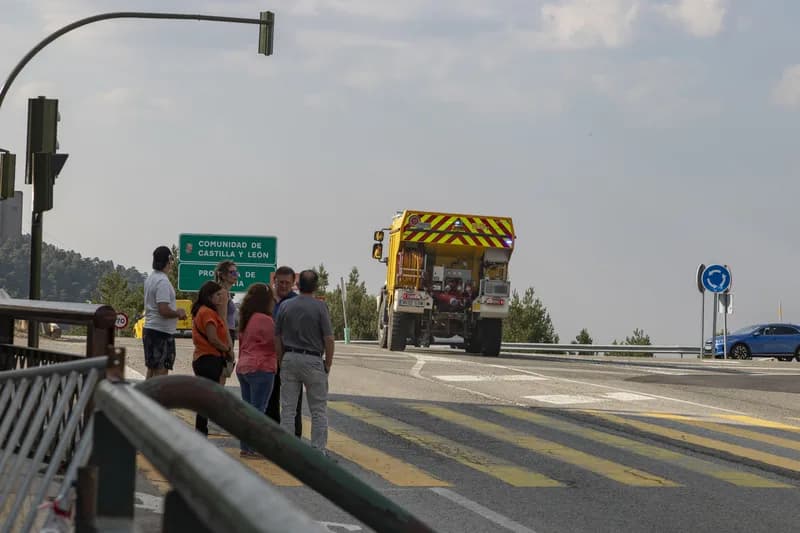
Wildfires driven by the heat and drought displaced hundreds of thousands of people and burned more than 1.23 million acres, mainly in Spain, France and Italy, on European Forest Fire Information System figures to August 6. Spain was hit hardest. By July 20 its 18 major fires had burned roughly 70,000 hectares of land.
By early August, on a running tally kept by the mapping site Mappr, the fires had killed at least 17 civilians, six firefighters and two helicopter crew members, and forced roughly 330,000 people from their homes in Spain and France alone. Greece battled major blazes near Athens. Copernicus satellite mapping of imagery from August 4 put the burn area across the Attica and Boeotia regions at about 14,424 hectares, while the Greek government's first assessment was closer to 11,100. The wildfire season ranked among the continent's worst on record.
The fires spread their effects well beyond the burn scars. Laurence Rouil, director of the Copernicus Atmosphere Monitoring Service, said the blazes increased emissions and disrupted air quality across the continent. Greece dispatched hundreds of firefighting crew and equipment for a second major fire near Athens after more than 10,000 hectares of pine forest had already burned.
Rivers fell to record low levels
Europe's four major rivers, the Loire, Po, Rhine and Danube, fell to record low levels in August, according to Copernicus. The drought had built up since early spring, deepening through a poor rainy season and repeated heatwaves before turning forests into fuel. River-flow forecasts from the Copernicus European Flood Awareness System pointed to low or extremely low discharge across many catchments in France, the Alpine region and eastern Europe.
The low water strained energy infrastructure. Slovenia's Krško nuclear plant, which also supplies Croatia, cut its reactor to 80 percent capacity because the Sava River ran too low and too warm to cool the facility adequately. Hungary asked companies and households to cut energy use as the drought deepened.
Hungary came close to a forced shutdown of its only nuclear plant. Prime Minister Péter Magyar disclosed that around 1:30 a.m. the country was, as he put it, a few millimeters away from completely shutting down the Paks Power Plant. The Danube's level stopped falling just in time and had risen 1.5 centimeters by the morning, easing the immediate crisis without lifting the underlying threat.
What is driving Europe's heat
The immediate driver of the 2026 heat was a persistent heat dome, a stationary high-pressure system that trapped hot air over the continent and blocked cooler air from moving in. As the high pressure settled, it compressed warm air downward and created a feedback loop that sustained extreme temperatures for days and, in places, weeks. Ongoing El Niño conditions in the equatorial Pacific, described by some forecasters as a Super El Niño, amplified the effect, Copernicus said.
Climate scientists point to background warming from fossil fuel emissions as the underlying cause. The World Weather Attribution initiative estimates that European heat waves are now at least 10 times more likely because of human-caused climate change, and that the June conditions would have been virtually impossible 50 years ago. Since 2000, Europe has warmed at roughly twice the global average rate.
The fastest-warming continent on Earth
Europe has warmed by around 2 degrees Celsius in the 50 years since the historic heatwave of 1976, a climate expert cited by the WMO said, making it the fastest-warming continent, with temperature extremes rising alongside the average. The organization mobilized early warnings and coordinated heat-health action plans across member states through the summer.
Many people still live, work, and study in places that are not designed for the temperatures we are now experiencing.
Warning systems ran at full stretch across the continent. The UK Met Office issued its highest-level extreme heat warning, forecasting severe impacts across England and Wales, while the UK Health Security Agency posted heat-health alerts for eight regions of England. Meteo-France placed more than half the country's departments under orange heat alerts.
Italy's Health Ministry said 25 of the country's 27 major cities were on red alert, with all of them expected to reach that level within days. The heat closed schools and disrupted power supplies in several countries, and public health officials repeatedly flagged the danger to older residents, outdoor workers and people with existing illness. Officials described strains cascading across the continent, from transport disruptions to power grid stress and water shortages.
Experts warned that the drought touched many sectors at once, from water management and agriculture to transport, energy and public health. Low, warm rivers threatened navigation and cooling for power plants, dry forests fed the fires, and the record marine heatwaves put sea life and coastal communities along the Atlantic and Mediterranean at risk.
More heat forecast into September
Forecasts point to more warm weather through August and into September, with continued heatwave risk across much of Europe, according to the Joint Research Centre. France 24 reported on August 10 that Britain and France were already under warnings for temperatures in the mid-30s Celsius, with the heat expected to move east again. Scientists say the pattern reflects a new normal that Europe's infrastructure, much of it built for a cooler climate, was never designed to withstand.
Sources
- Copernicus: Record heatwave brings hottest June for western Europe during second-warmest June globally
- Europe Heatwave 2026: WMO Warns of Rising Extreme Heat
- Western Europe breaks temperature record in summer plagued by heatwaves and wildfires
- Worsening drought and record heat grip Europe, fuelling extraordinary wildfires and extremely low river flows
- Wildfires Across Europe in 2026: Mapping the Fires, the Deaths, and the Record Heat
- Europe's heat wave set records for all-time highs
- Another heatwave hits Europe as drought and fires worsen
- Europe's heat wave fuels drought, wildfires and fears about energy supplies
- Europe Heat Wave 2026: Records, Risks & What Comes Next