Etna ash extends Catania airport closure to Saturday
Around 700 flights have been cancelled in the worst disruption to hit the airport in at least two decades.
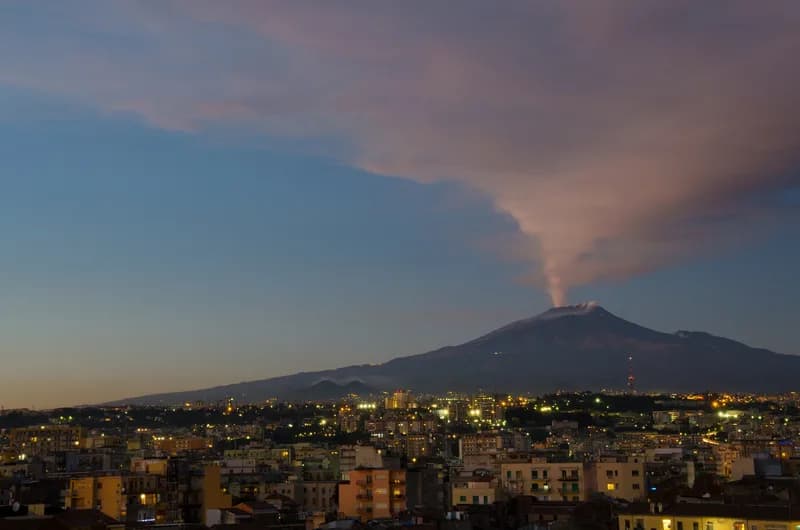
Arrivals at Catania airport in Sicily will remain suspended until 2 a.m. local time on Saturday, August 15, as ash from Mount Etna's continuing eruption keeps airspace sectors around the airport closed, the airport operator SAC said in a statement late on Thursday, August 13. The extension pushes the disruption past a full week, a stretch in which hundreds of flights have been cancelled or rerouted at one of Italy's busiest summer gateways.
Catania, Italy's fifth-busiest airport by passenger traffic, sits about 30 kilometres (19 miles) from the volcano on Sicily's eastern coast. Between August 6 and 12, around 630 flights were diverted to other airports, including Palermo, Trapani, Comiso and Lamezia Terme in Calabria, and more than a third of the 1,974 flights scheduled to arrive at Catania over that period were cancelled, SAC said.
It is the longest emergency at Catania since 2002. About 700 flights, arrivals and departures combined, have been cancelled since it began, according to SAC. Around 400 departures were scrapped between August 8 and 11, with another 52 due to go the following day, and more than 250 flights were diverted over the same window, including over 100 to Comiso.
A week of closures at Fontanarossa
The repeated shutdowns reignited a long-running political and infrastructure debate in Italy over Sicily's airport network. Nello Musumeci, the Minister for Civil Protection and Maritime Policies, said the cancellations and delays at Catania and nearby Comiso had brought back a problem the region had long known about, and said that as president of the Province of Catania in 1999 he had pointed out the limits of the Fontanarossa site and put a proposal to relocate the airport into the provincial plan, along with a preliminary study for a new airport on the plain between Catania and Enna.
What has been happening in recent days at the airports of Catania and Comiso, with cancellations, delays and serious disruption for thousands of citizens and tourists at the height of the summer season, brings back to the fore a problem that Sicily has known about for a long time.
Catania handled about 12 million passengers in 2024, a figure that rises sharply during the August peak. The eruption struck in the middle of the summer holiday season, magnifying its effect on travellers and on the tourism economy that leans on them, and the repeated shutdowns over recent weeks have compounded the strain on the region.
Thousands of passengers have been stranded by the prolonged closure, with some spending days inside the terminal, sleeping where they can and passing the time playing cards. Antonella Thirande Warnakulasuriya Costa, from Messina, said her Wednesday flight was cancelled and her rescheduled Friday flight was cancelled too, leaving her stuck as she tried to reach Sri Lanka by way of Dubai. Civil protection volunteers moved into the regional terminals to help those left waiting.
Matheus Paulo Neto, a traveller from João Pessoa in Brazil, said his flight had been changed twice while he tried to reach Olbia, and that he had received little assistance and confusing email messages. Other passengers described exasperation over small food vouchers and limited rental car availability as the days stretched on inside the crowded terminal.
Ash drifts to Malta and Libya
The eruption's ash column has stretched well beyond Sicily. On August 12, the plume reached Malta and as far as the Libyan coast, forcing flights into Malta to alter their routes to stay clear of it. Only about 10 percent of Catania's scheduled flight movements were still operating during that day's suspension, according to AirHelp, which also counted 190 flights handled by Palermo in recent days that had originally been due at Catania.
Cancellations and diversions rippled far beyond the island. Flights to Amsterdam, Paris, Edinburgh and New York JFK were among those affected, AirHelp reported, and airports taking diverted traffic ran into ground-handling bottlenecks and shortages of onward transport, leaving some passengers stranded even after their plane had landed elsewhere. INGV confirmed Etna's effusive activity was continuing and the aviation alert stayed at red.
INGV's Etna Observatory has kept the aviation colour code at red, its highest level, since raising it from orange on August 9. Surveillance cameras showed intense and continuous explosive activity at the Voragine crater, with volcanic bombs falling in the summit area and abundant ash dispersing south-southwest towards Catania. Etna is Europe's highest and most active volcano, about 3,400 metres at the Voragine rim, and its nearness to a major airport makes each ash-heavy phase a threat to inbound approaches.
Why ash closes an airport
Volcanic ash is dangerous to aircraft because it carries fine glass particles that can melt inside a jet engine and cause it to fail, which is why aviation authorities respond with red-alert closures. In 1982, a British Airways Boeing 747 temporarily lost power in all four engines after flying through ash from Indonesia's Mount Galunggung, before the crew restarted them and landed safely.
In relation to the situation, with a strong operational impact, we invite passengers not to go to the airport without first checking the status of their flight directly with the airline. The situation is being constantly monitored, and further updates will be provided as the volcanic activity and weather conditions evolve.
SAC repeated that advice throughout the week, closing sections of airspace one after another as the ash cloud shifted with the wind. On August 8 it suspended arrivals until midday, on August 10 it shut Sector C1 to the southwest and held arrivals until 5 p.m., and on August 12 it closed Sector B3 and suspended all arrivals and departures until 2 a.m. on August 14. The statement late on August 13 extended the suspension of arrivals by a further day.
The eruption traces to the Voragine crater, which opened a fissure in late June and reactivated after a phase that had begun in 2024. That reactivation is why the current episode has produced multi-day closures rather than the brief interruptions Catania has weathered before. The crater's abundant ash and its position above the airport have repeatedly forced closures whenever the wind pushes the plume south.
An earlier flare-up in July had already grounded flights, after the Voragine crater opened a fissure on June 26 and ash emissions intensified on July 5.
By August 11 the effect was visible across the continent. FlightAware recorded 2,204 delays and 229 cancellations across Europe that afternoon, with Catania accounting for 98 of the cancellations and 23 of the delays. Barcelona-El Prat logged the most delays anywhere in Europe, at 282.
Airlines hit hardest
Ryanair, easyJet, ITA Airways and Wizz Air, which operate the largest share of flights to Catania, absorbed most of the cancellations. Ryanair alone logged 51 cancellations across Europe on August 11, while easyJet recorded 220 delays that day. Airlines were expected to restore cancelled services gradually rather than all on the same day, so backlogs could persist even once the airspace reopens.
How Sicily rerouted the traffic
Traffic that could not reach Catania was pushed to other Sicilian airports, and to Lamezia Terme on the Calabrian mainland. More than 100 flights were rerouted to Comiso once the emergency began, while Palermo took the largest share, absorbing about 190 Catania flights over the course of the emergency and about 50 diversions on August 11 alone. On August 12, SAC logged 40 diverted arrivals to Palermo, 12 to Trapani and five to Comiso, and 50 departures that would have left Catania operated instead from other airports: 33 from Palermo, 14 from Trapani and three from Comiso.
Comiso briefly halted operations because of ash fall before reopening to accept rerouted services, and Trapani took a smaller stream that included 22 flights over the period. For many travellers, though, landing at an alternate airport was only the start; reaching the intended destination often meant a long onward trip by road or rail.
Palermo lies about 230 kilometres, or 143 miles, from Catania, a road transfer of three to five hours. Sicily's regional government arranged onward transport from Palermo, Trenitalia added six extra trains on the Palermo to Messina to Catania route, and passengers diverted to Comiso, where public transport connections are limited, were left to rely largely on private car hire.
What passengers are owed
Because the closures stem from a natural event outside airline control, volcanic eruptions are treated as extraordinary circumstances under EU Regulation 261. Passengers are therefore unlikely to receive the cash compensation, typically 250 to 600 euros, that applies when a disruption is the carrier's fault. The duty of care, however, still stands.
| Provision | Status under EU261 |
|---|---|
| Cash compensation of 250 to 600 euros | Not owed; the eruption is an extraordinary circumstance |
| Rebooking to the destination | Owed as part of the airline's duty of care |
| Meals and refreshments | Owed while passengers wait |
| Hotel accommodation | Owed if an overnight stay is needed |
That care includes rebooking, meals and refreshments while passengers wait, and hotel accommodation when an overnight stay becomes necessary. Travel advisers suggest keeping every receipt and contacting airlines through their websites or social media channels rather than by phone, since call lines have been overwhelmed by the volume of stranded passengers seeking new flights.
Airlines were rebuilding the schedule gradually rather than restoring every cancelled service at once, so rebooked passengers faced waits of several days in some cases.
For those diverted west, the rail and road corridors stayed clear of the high-altitude ash cloud. Trenitalia regional links and SAIS Autolinee bus transfers offered ways to connect from Palermo, while carriers advised passengers dropped at Palermo or Comiso to check with them about shuttle options. Rail and road remained the most reliable way onward while the ash lingered at altitude.
With arrivals set to resume at 2 a.m. on Saturday, the timeline now depends on the volcano. INGV instruments were showing steady tremor with no immediate escalation, but SAC said the situation was being monitored constantly and that further updates would follow as Etna's activity and the weather conditions evolve over the coming days.
Sources
- Reuters (via U.S. News): Etna Eruption Extends Closure of Sicily's Catania Airport Until Saturday
- UNN: Mount Etna Eruption: Catania Airport Closed Until August 14, Around 700 Flights Cancelled
- Euronews: Mount Etna Eruption: Catania Airport Closes and Ash Cloud Reaches as Far as Libya
- AirHelp: Catania and Malta Flights Hit by Mount Etna Ash Cloud
- The Watchers: Intense Mount Etna Eruption Sends Ash South, Catania Airport Suspends Arrivals
- Al Jazeera: Mount Etna Ash Suspends Arrivals at Italy's Catania Airport
- Tech Times: Catania Airport Suspends Arrivals Third Time in Five Days as Etna Ash Persists
- Travel Tourister: Mount Etna Eruption Catania Airport Closure: Red Aviation Alert Triggers Flight Chaos in Sicily
- Nomad Lawyer: Mount Etna Eruption Triggers Flight Cancellations at Catania and European Airports