Alibaba prices $10.2 billion AI share sale at 8.4% discount
The 710 million shares are the largest primary follow-on by a Hong Kong-listed company and drew $28 billion in orders.
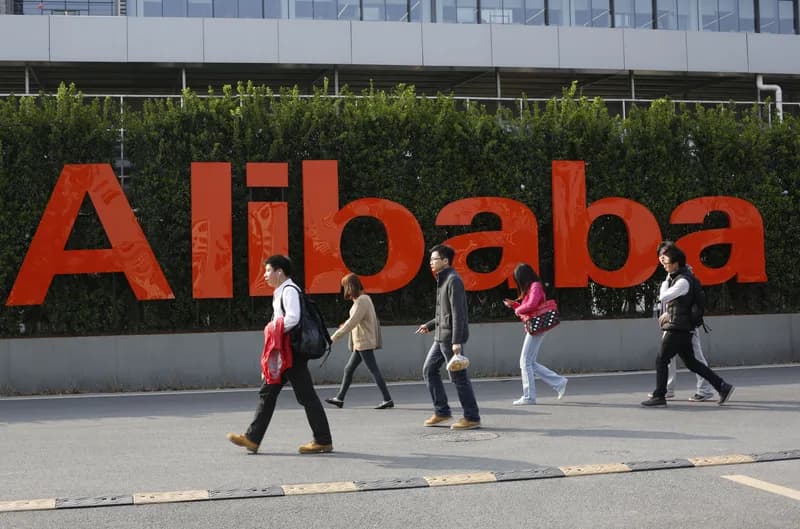
Alibaba shares fell as much as 10% in Hong Kong on Monday, to HK$110.10, after the company priced a HK$80 billion ($10.2 billion) placement of new shares to fund its artificial intelligence buildout. The stock ended the morning down 9.8% at HK$111.00, below the HK$112.70 at which the new shares were sold.
The company will issue 710 million new shares at HK$112.70 apiece, an 8.4% discount to Friday's closing price of HK$123, according to its regulatory filing. All of the net proceeds will go toward what Alibaba calls its full-stack AI capabilities, including expanding and enhancing its AI infrastructure. The company did not break the spending down further in its announcement.
Two things unsettled investors: the dilution, and how long the spending will take to pay off. Because the placement is a direct issuance of new equity rather than convertible debt, it immediately increases the share count and shrinks each existing holder's stake. That concern mirrors a debate in the United States, where investors increasingly question when heavy AI outlays will generate returns.
What Alibaba is selling
The deal, expected to close on Wednesday, is the largest-ever primary follow-on offering by a Hong Kong-listed company and the third-largest primary follow-on share sale anywhere this year, after offerings from Alphabet and Intel, according to Reuters.
- 80 billion Hong Kong dollars raised, about $10.2 billion
- 710 million new shares at HK$112.70 each
- 8.4% discount to the HK$123 Friday close
- 100% of net proceeds directed to AI capabilities
- Expected to close Wednesday, August 26
The offering drew strong demand despite the sell-off. Order books reached $28 billion, with $6 billion of that from long-only and sovereign investors, according to Reuters, which cited three people with knowledge of the deal. Demand ran high enough that Alibaba priced the deal at the full HK$80 billion.
The placement was not registered under U.S. securities laws and was structured as an offshore transaction, meaning American investors could not take part. About 40% of the book was to be allocated to long-only and sovereign buyers, investors that tend to hold a stock rather than trade it, two of the people said. Those buyers included major sovereign wealth funds in Europe, Asia and the Middle East, the people said.
Long-only and sovereign investors typically hold for longer, which can soften selling after a deal closes. Even so, the stock fell through the placement price in early trading, a common pattern for accelerated, institution-only sales, as existing holders treat the discounted clearing price as the session's new reference.
Why the stock fell
Two forces pushed the price down at once. Existing shareholders worried about dilution, while traders sold down to and through the deal price, which marked the clearest signal of where fresh supply could clear in the market.
The reaction echoed a worry that has spread across global markets, that the enormous sums going into AI may take years to produce profits. Alibaba underlined the point days earlier, reporting that quarterly net profit fell 75% from a year before, weighed down by that spending. The new shares represent about 3.6% of the company's enlarged share capital.
"It's negative news in the short-term ... as the share placement dilutes shareholders' interest," said Charles Wang, chairman of Shenzhen Dragon Pacific Capital Management. "In addition, investors generally don't like capex ... though the investment is beneficial in the long term." The doubt runs deeper for some, who question whether an e-commerce company can win an infrastructure race against dedicated technology rivals.
Funding the AI push
Alibaba has made AI and cloud computing the center of its growth strategy. It pledged last year to invest at least 380 billion yuan ($56.5 billion) in cloud and AI infrastructure over three years, one of the largest such commitments by a Chinese company. As of the end of June it had deployed about 190 billion yuan, roughly half the plan.
Alibaba's DNA is in e-commerce, not advanced tech. No matter how much it invests in AI hardware, it will likely be outmaneuvered by competitors in tech innovation.
Alibaba's leadership has tried to reassure the market on returns. The company brought forward its projected payback on the AI investment to two and a half years from three, citing surging demand for AI services, and management says computing power still falls short of what customers want to buy. Chief Financial Officer Toby Xu said deepening synergies across the business and ramping AI monetization give the company "greater strategic and financial flexibility" to keep investing.
Chief Executive Eddie Wu said the company expects its AI computing investment to break even within three years, and possibly in about two if gross margins keep improving. He called the June quarter strong, "driven by the improving commercialization of our full-stack AI capabilities," pointing to language, coding, video, audio, image and music models the company has released.
The spread of analyst price targets on Alibaba remains wide, reflecting how much rests on when the spending finally turns into profit. On the quarter just reported, revenue of 268.95 billion yuan came in just ahead of the 268.88 billion yuan analysts had expected, according to LSEG data.
Alibaba Cloud has kept expanding its physical footprint alongside the spending. Last week it opened its third data center in South Korea, taking the network to 104 availability zones across 30 regions, part of the same infrastructure pledge announced last year. Cloud revenue accelerated to 45% growth in the June quarter, which the company offers as evidence that real demand exists for the capacity it is racing to build.
Set against US spending
The raise is small next to what the largest U.S. technology firms are spending. Capital Group estimates that AI-related capital expenditure by Microsoft, Amazon, Alphabet, Meta and Oracle reached $791 billion as of July 31, much of it on AI data centers, chips and cloud infrastructure.
What the raise means for shareholders
The placement forces Alibaba's shareholders into a trade-off. In return for immediate dilution, the company gains cash to fund a larger AI and cloud opportunity than its balance sheet alone would support, at a moment when it says demand for computing power outstrips what it can supply. Whether that proves a good bargain turns on converting the spending into profitable growth, and on that question the market has yet to be convinced.
The company's cash reserves have been draining as the buildout accelerates. Cash and other liquid investments fell to 474.51 billion yuan at the end of June from 520.82 billion yuan three months earlier. Operating cash flow stayed positive at 22.95 billion yuan, up 11% from a year earlier, but free cash flow was an outflow of 44.67 billion yuan.
Capital expenditure jumped 75% year-over-year to 67.7 billion yuan, almost $10 billion, in the June quarter alone, which means the entire placement roughly covers a single quarter of spending at that pace. Executives have said the outlays will not be linear from quarter to quarter, leaving investors to judge each period against an uneven schedule.
What the earnings showed
Alibaba's June-quarter results, reported days before the placement, show a company growing revenue while profit shrinks under the weight of its investments. Total revenue rose 9% from a year earlier, while net income fell by three quarters and the operating margin more than halved.
| Metric | June quarter 2026 | Change from a year earlier |
|---|---|---|
| Revenue | RMB268,953 million | Up 9% |
| Net income | RMB10,444 million | Down 75% |
| AI Cloud and Compute revenue | RMB48,437 million | Up 45% |
| Capital expenditure | RMB67.7 billion | Up 75% |
| Operating margin | 6% | Down from 14% |
AI-related product revenue delivered triple-digit growth for the twelfth consecutive quarter, the company said, reaching 12.38 billion yuan ($1.8 billion) in the quarter. Adjusted EBITA for the AI Cloud and Compute unit rose 133% to 5.63 billion yuan, even as group net income fell and free cash flow turned to an outflow.
Alibaba overhauled its reporting structure in the same quarter. It folded its e-commerce arms into a single Alibaba E-commerce Group, merged the cloud business with the T-Head semiconductor operation into AI Cloud and Compute Services, and grouped the Qwen models and enterprise tools into a new AI Labs and Applications segment.
T-Head's chips already reach scale. Its Zhenwu processors serve more than 650 external customers across more than 20 industries through Alibaba Cloud, the company said, central to the full-stack approach that runs from silicon to models and applications.
The placement is due to close on Wednesday, August 26. A clean close would lift Alibaba's liquidity before fees, while a weak share response would signal that investors want firmer evidence of AI returns before funding another round of spending. Monday's reaction leaned toward the latter.
Sources
- CNBC: Alibaba plunges after announcing $10.2 billion share placement to fund AI push
- Investing.com: Alibaba stock slumps in Hong Kong after $10.2 billion share placement to fund AI
- Business Day: Alibaba launches $10.2bn share sale to fund AI expansion
- Reuters via Lufkin Daily News: Alibaba stock slumps in Hong Kong after $10.2 billion share placement to fund AI
- Finimize: Alibaba's $10.2 Billion AI Share Sale Spooked Investors
- BiggO Finance: Alibaba Launches First Share Placement Since Hong Kong Listing
- TS2: Alibaba's $10.2 Billion AI Share Sale Matches Quarterly Capex as BABA Dilution Looms
- Alibaba Form 6-K: June Quarter 2026 Results
- Alphamatch: Alibaba's US$10 Billion New Share Issuance
- Investing.com: Alibaba Q2 2026 slides, AI surge drives revenue up 9%, profit down 75%