Hurricane Lala destroys six bridges, cutting off Hawaii's Kaʻū District
Hawaiian Electric warned rural outages could last months, and officials have confirmed no deaths from the storm.
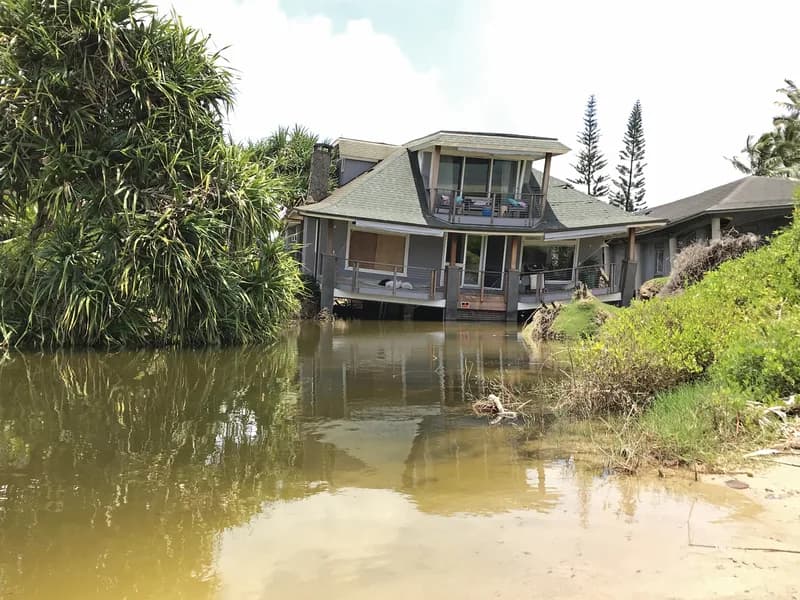
Hurricane Lala passed about 30 miles off Hawaiʻi Island at hurricane strength on the evening of August 15, driving ferocious winds and torrential rain across the southern coast before turning west. Mayor Kimo Alameda of Hawaiʻi County counted six bridges destroyed or badly damaged after an aerial survey the following day, and Governor Josh Green put the number of homes hit at more than 100, several of them swept off their foundations by flash floods in the Kaʻū District.
Green said at a news conference on August 16 that 100 or more homes on the southern part of the Big Island had been destroyed or damaged, an estimate rather than a count. Alameda said some homes were swept off their foundations, and that the county's civil defense was working with local agencies, the National Guard and the Coast Guard on a search and rescue mission after flash floods pushed several occupied homes off their footings.
Kaʻū District cut off by damaged bridges
Alameda flew over the district with the acting civil defense administrator, Darryl Oliveira, and described what he saw as devastation, counting six bridges in the Kaʻū area badly damaged or destroyed. Green put the number at eight. The wreckage left Pāhala, along with Kaʻū Hospital, cut off, and floodwaters from Paʻauʻau Stream burst a rock wall and collapsed a stretch of Highway 11 in the town.
When you have 28 inches of rain, there's going to be a ton of landslides.
The National Weather Service issued a life-threatening flash flood emergency for parts of the Big Island, including Nāʻālehu, Pāhala and Hawaiian Ocean View. Rain fell at 3 to 5 inches an hour in places, well beyond the 25 inches forecasters had said was possible at higher elevations before the storm. Laupāhoehoe recorded 29.3 inches in the 24 hours to 8am on August 16 and Pāhala 23.66, and the Weather Prediction Center estimated more than 43 inches in the Big Island mountains.
Two homes in Waiʻōhinu, below Highway 11, were caught by the flash flooding on the evening of August 15. One washed off its foundation and the other shifted from its site. Responders pulled an elderly woman from a tree after her house washed away.
Honolulu EMS took more than 200 people to hospital during the storm, and at least three hospitals were running on generator power, Green said. A paramedic and an EMT climbed onto the roof of their ambulance after floodwaters pushed it against a guardrail, and were lifted out by a National Guard high-water vehicle. At the county cemetery in Nāʻālehu, graves were unearthed and at least one casket was left resting on a mound of mud.
Green counted 215 people in Big Island shelters on the morning of August 16, with another 117 in refuge areas on Oʻahu. In Kaʻū, 41 were at the Nāʻālehu shelter and about 13 at Pāhala, with 15 more sheltering at a neighbour's house. Most reached the shelters on their own.
Power could stay out for months
Hawaiian Electric warned that power could remain out for weeks, or even months, in some of Hawaiʻi Island's hardest-hit rural regions, where transmission lines run through wooded areas and albizia trees can take out lines. The utility was inspecting downed lines by helicopter, dependent on weather conditions, and said hundreds of personnel were working to restore service across the islands.
| Time | Customers without power |
|---|---|
| Sat 15 Aug, 3pm | About 44,000 statewide |
| Sat 15 Aug, evening | More than 60,000 on Hawaiʻi Island |
| Sun 16 Aug, 7am | About 197,000 across Oʻahu, Maui and Hawaiʻi Island |
Source: Hawaiian Electric. Figures are customers, meaning meters, not people, and exclude Kauaʻi, which is served by KIUC.
Four of Hawaiian Electric's independent power providers on Hawaiʻi Island were disconnected from the grid by storm damage, and the company said it might have to shed load to keep the system stable. About 197,000 Hawaiian Electric customers on Oʻahu, Maui and Hawaiʻi Island were without power at 7am on August 16 as Lala moved south of the islands. Hurricane-force gusts were reported in Hawaii, Honolulu and Maui counties. Kauaʻi is served by a separate utility and is not in those figures.
Green counted 19 buildings with their roofs torn off on the evening of August 15. The tally rose sharply overnight: the Honolulu Fire Department alone logged 39 blown roofs and 58 downed trees among more than 120 storm calls by 2am. A wind gust of 45 mph was recorded at Daniel K. Inouye International Airport in Honolulu, and Lala's maximum sustained winds reached about 80 mph at its closest approach.
Two deaths under investigation, neither confirmed as storm-related
Officials have confirmed no storm fatalities. Two people died over the weekend and both cases are open. A 45-year-old man from the Ocean View Estates subdivision was killed in a head-on collision on Aloha Boulevard at about 1.17pm on August 15; the 21-year-old woman in the other car is in a critical condition. Hawaiʻi County's interim fire chief, Dan Volpe, said the crash is not considered storm-related. On Oʻahu, a body was found near Kalihi Stream, and Honolulu Mayor Rick Blangiardi said the city was working out whether the storm played a part. Alameda said on August 16 that despite the devastation there were no reports of storm-related deaths.
Volpe said one resident was swept about 100 yards after going out to her vehicle. Responders found her on the morning of August 16 and took her to hospital with moderate injuries, awake and alert. He reported no unresolved missing-persons cases, though crews kept searching the isolated Kaʻū communities until every area had been covered.
Three people were seriously injured after a tree fell on them in Puna, officials said. Hawaii National Guard personnel volunteered for State Active Duty to support Hawaiʻi County, and the county's Public Works Department worked with the state and the Guard to reach Kaʻū communities on the east side. Rescue crews carried out numerous water rescues through Saturday night, responding to emergency calls and flooded roadways as fast-moving runoff overtook roads and bridges across the district.
South Point Road was cut off and power lines were down on Highway 11 heading toward Ocean View. Christine Inserra, who lives in Waiʻohinu just south of Nāʻālehu, tried to enter the town for a welfare check on friends but was turned around by county workers at Kahuku Park.
Businesses and a school left in ruins
The Punaluʻu Bake Shop was inundated by floodwater, mud and boulders. Its general manager, Zach Kennedy, wrote on social media that the business had suffered catastrophic damage. The hardest-hit communities were Nāʻālehu, Waiʻōhinu and Pāhala, where small streams turned into rivers that smashed roads and cut off the Green Sands Beach Subdivision.
Nāʻālehu Elementary School flooded and is closed to students and staff from August 17 to August 20, because of damage to its campus and classrooms and road closures blocking safe access. Kaʻū High and Pāhala Elementary are closed on August 17 only. Inserra said she had four-foot trenches in her yard where trees had been uprooted, and no cell service.
Rare hurricane skirted the Big Island
Lala made its closest approach to Hawaiʻi Island at about 5pm on August 15, its eyewall brushing the southern coast from roughly 30 miles offshore as a Category 1 storm with sustained winds near 80 mph. Only the eyewall and a small part of the eye passed over land, short of the definition of landfall, which requires the centre of the eye to cross the coast. Lala held minimal hurricane status for less than 18 hours.
Warm water and El Niño fueled the storm
Tropical storms approaching Hawaii usually cross cooler water that weakens them before they arrive. Lala instead stayed over warm water, sustained by a marine heat wave that stretches across the Pacific to the California coast and by a strengthening El Niño. The NOAA Climate Prediction Center's August 13 discussion put the chance of a very strong event by winter above 90 percent. El Niño raises central Pacific activity, bringing warmer seas and weaker upper-atmosphere winds that would otherwise tear storms apart.
NOAA's 2026 Central Pacific outlook, issued in May, gave a 70 percent chance of an above-normal season and forecast 5 to 13 tropical cyclones in the basin. A 2013 study in Nature Climate Change by Hiroyuki Murakami and colleagues projected a two to threefold increase in tropical cyclones near Hawaii by the end of the century as the climate warms.
The storm drew comparisons to Hurricane Iniki, the Category 4 that hit Kauaʻi in September 1992, also an El Niño year, causing about $3 billion in damage, destroying more than 1,400 homes and killing six people. Lala's path also raised memories of the 2023 Lahaina wildfires, which burned in extreme winds while Hurricane Dora passed far to the south, though later analysis found Dora had little to do with them.
In the Central Pacific Hurricane Center's 5am advisory on August 17, Lala was about 360 miles west of Honolulu with sustained winds of 60 mph, moving west at 12 mph, with tropical-storm-force winds reaching 105 miles from its centre. All coastal watches and warnings have been discontinued. Forecasters expect it to strengthen back into a hurricane by Wednesday, well west of the island chain.
What officials warned residents to expect
Green closed all state and county offices, schools, courts and Judiciary offices for August 17. A flood watch held overnight for Kauaʻi, Oʻahu and Maui counties, and officials on Oʻahu opened eight hurricane refuge areas while public facilities including the Honolulu Zoo shut. Hawaiʻi County reported a record number of road closures.
- Lala's outer bands could bring one to four more inches of rain, with some spots getting six
- Life-threatening surf and rip currents were forecast to continue into Monday
- Flooding and mudslides remained possible, especially in areas of steep terrain
- Dry, breezy conditions outside the storm elevated fire concerns
The storm's effects were expected to leave the Hawaiian Islands by 8 a.m. Monday, with the large waves Lala generated gradually trending down through the day. Hawaii Farm Bureau Director Brian Miyamoto said growers still recovering from earlier damage were worried about the new losses. Acting Civil Defense Administrator Darryl Oliveira said the Kaʻū District would face long-standing road and bridge challenges, creating access issues for residents who might be isolated for some time.
Sources
- Hawaiʻi Island communities cut off by floods, road damage in wake of Lala
- Tens of thousands without power and more than 100 homes damaged as Tropical Storm Lala moves away from Hawaii
- Lala weakens to tropical storm, brings heavy rain, wind, flooding to Hawaii
- Tropical Storm Lala drenches Hawaii as flash floods sweep away Big Island homes
- Hurricane Lala devastates Ka'ū District; damaged bridges block access to communities
- Hurricane Lala brings devastation to Ka'ū; Hawai'i County holding press conference with recovery efforts
- 1 dead, homes swept away as Hurricane Lala brings heavy rain to Hawaii's Big Island
- Lala's Wrath: Homes Swept Away, Some Power Outages May Last Months
- Hawaiian Islands brace for Lala this weekend
- Hurricane Lala lashes Hawaii's Big Island, leaving 1 dead